Wednesday, August 31, 2005
Flying Spaghetti Monsterism on campus
Pastafarians rule the world - the Facebook has groups of followers of the Flying Spaghetti Monster!
Pastafarianism Rocks!
The Flying Spaghetti Monster made it big....really BIG!
Countering the Campus Crusade For Christ
SECULAR STUDENT ALLIANCE REPORT (USA)
In mid-August, the Co-Directors participated in the SSA national convention at
The Ohio State University in Columbus. Student activists from across the nation
attended the well-planned and executed conference. The overall conference theme
was: "Connecting the Secular Movement with Other Communities." Our own topic
focused more on the endeavor to link secular people themselves to each other.
In the PowerPoint presentation ("Connecting the Unconnectables: A Case Study
from The Brights' Network"), we explained to students this endeavor to link up
independent thinkers (who are generally not "joiners" by nature) so they can
press for civic fairness as part of an Internet constituency. Spreading the word
to those of similar bent can help build the constituency. Each constituent is
encouraged to more positively and candidly express naturalistic inclinations and
be assertive about their rights to be acknowledged and able to participate in
society.
If you know a college age student, you may want to guide him/her to:
Secular Students (from the Brights-Net)
Feeding the Christian Persecution Complex
The Secular Coalition for America has hired a Washington, DC lobbyist for
non-religious Americans. The SCA, a coalition of non-religious organizations, has selected Lori Lipman Brown, a former Nevada State Senator, as its new director/lobbyist. She is a superb choice to represent the rights of all secular Americans whatever their self-identity (humanists, atheists, freethinkers, rationalists, Brights, etc.). The 501(c)(4) tax status of the Secular Coalition for America enables political lobbying. Read about the new lobbyist and the SCA itself at:
Secular Coalition (from the Brights-Net)
New Carnivals
Circus of the Spineless, a monthly covering writing and original photography of Invertebrates.
Blogarithmicly, a hypercarnival of link-harvests has already had the
first edition.
The Nature Writers of Texas collects seriously good nature writing.
Tuesday, August 30, 2005
Grand Rounds
The newest edition of
Grand Rounds is up!
Monday, August 29, 2005
Karnival od Kidz
Karnival of Kidz is up!
Tar Heel Tavern
Tar Heel Tavern #27 is up on Ogre's place.
Sunday, August 28, 2005
Framing War On Terror
9/11 has
nothing to do with New York City. Really, the two big towers that fell were in Peoria....
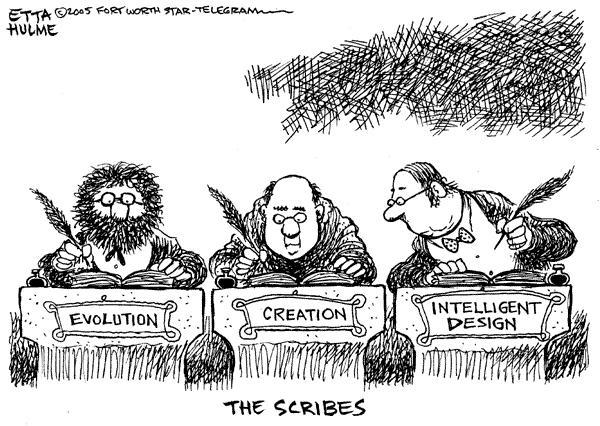
Evolution Today

(cartoon - hat-tip:
Stranger Fruit)
Daniel Dennett
slams Intelligent Design Creationism in today's NY Times.
Zimmer explains
co-evolution of insects and flowers.
Evolutionblog deconstructs an IDiotic
article in "American Thinker".
Mike writes about a new and dangerous
drug-resistant bacterium.
Shakesepeare's Sister puts 2 + 2 together on
he-said-she-said jorunalism and more....
Revere puts a new spin on the
Blind Watchmaker story.
Abnormal Interests on
Relativism for Creationists and on an op-ed in
LA TimesChris chimes in on Elizabeth Lloyd's
struggle with bloggers and I am sorry but I did not link to a whole series of recent great posts
on his blog so just go and read for yourself. (PZ also writes on
Lloyd)Arthur Silber,
Amygdala and
PZ Myers on IDC misuse of Dinosaurs to get at the kids while they're young.
Evil Monkey
describes his PhD
defense.
Dispatches from the Culture Wars on a Creationist
lawsuit against University of California system (which denies entry to students who were indoctrinated in religious schools instead of educated). Pharyngula
has more. So does
Amygdala.
Jesse of Pandagon skeweres it further.
DarkSyde on the
terror-bird.
The Rational Thinker on the petition by ISU
faculty and staff to reject intelligent design Creationism.
Dyticas Chronicles:
Human aging: intelligent design?
Around the Neighborhood (NC bloggers)
Too Clever By Half is going to have one
long semester and the comments thread is interesting. Look around - a good blog.
Reason and Radical got an anti-IDC ("Intelligent Design Creationism") Letter to the Editor
published.
NC Bad Drivers
rants against, well, bad drivers!
Lex wrote an excellent
post about being a soldier and much, much more.
Stinging Nettle revisits and old
published article about the Patriot Act, as current today as it was in 2001.
Mr.Sun produces a Blogger's Pyramid of
Hierarchy of Needs. Funny and True!
Chewie and Ed Cone are
following the Truth and Reconciliation hearings in Greensboro - the first of its kind in the USA, modelled after the South African experience.
Dolphins stranded on the NC beach.
Is It Possible to Be a Groupie for a Book?
Do you want to take your kids to do some
nature and gardening stuff this fall in NC?
Dave has a
message for Rush Limbaugh.
Henry:
Who's your parasite?
On Pam's House Blend, Russ on the new IDC bill in
South Carolina and Pam on the financial states of
televangelists.
Melinama recalls a
disastrous gig and her daughter is now
safely in New York.
Dirty Greek discovers a pro-industry shill spouting
nonsense against Jared Diamond's "Collapse" in a so-called "scientific journal" published by a think-tank.
If memory serves me right, The First Year Teacher is now a third year teacher and the school year is
starting.
Is UNC summer reading a
controversy,....
again?
Jude addressses some
myths and some more
myths.
Earthquake? Here?
Drew
deconstructs the Scaife Foundation.
Robust McManly Pants reports on the new "modest"
Christianity movement to put women back into the kitchen.
Swamp Stuff and
Swamp Things are two beautiful nature/photography blogs.
You can find many more on the
NCblogs aggregator and on the
Tar Heel Tavern blog carnival.
Even more on female orgasm
When Elizabeth Lloyd wrote
this blog post about the thesis of her book on the evolution of female orgasm, many feminist bloggers misinterpreted her and bashed her wildly.
She has now written a
response to all of them (which includes links to their rants, plus a link to a very generous apology from one blogger - actually the only blogger on that list that I know and read). Several other (not listed) feminist bloggers that I like a lot, have also posted similar knee-jerk responses.
The natural suspicion towards Evolutionary Psychology which is mostly very mysoginist, combined with atrocious reporting by the media, further combined by lack of time to research the issue, plus lack of deep understanding of evolutionary theory, plus the urge to post a lot and often (and no editor to check facts), results in such reflexive responses on blogs.
Another recent example of decent research misinterpreted by the media resulting in knee-jerk rants by feminist bloggers can be found
here.
Pharyngula and Steve Mann
comment in Lloyd's defense. (My original comment is
here - a positive account so it did not make Lloyd's "Hall of Shame").
Saturday, August 27, 2005
Public Face of Orgasm
I have mentioned this site before and
here is the interview with one of the founders/owners.
Friday, August 26, 2005
Cockroaches
Watch out if you buy a new stove at
Lowe's:
Updated Categories!
Since my old computer died in February I had to deal with a few old bad machines which made blogging difficult. So, I gave up on keeping my "Archives By Categories" updated. Now that I have a decent computer again, I decided to update the categories. It was a huge job! I had no idea how much I post here! But now, it is done, so please look them up, especially if you are a relatively new reader of this blog.
In the category
Pure Science I try to keep the policy/politics to the minimum. It is mostly posts covering cool research, old or new, in papers, in books, or on blogs.
I never managed to jump on the Friday cat blogging bandwagon, so the category
Cute Animal Pictures is the smallest so far.
Posts specifically on
Evolution are separated from the Pure Science for easier access. Those also may contain a little bit more politics.
I wish I could ignore
Creationism and not waste my time, energy and nerves on it, but as it is on upswing now, I feel I have to follow it regularly.
Science Policy addresses other aspects of politization of science, as well as science funding.
Considering that the
Environment is so important to me, I am surprised how little actually I wrote about it during the past year.
The backbone of this blog is a long series of posts on
Understanding America. I try to understand the Red-Blue divide and the psychology of ideology. I mostly critique, modify and build upon Lakoff's model.
However, Lakoff jumps straight from Dobsonian childrearing as a cause to conservative politics as a result. I feel that there is a missing step here. I think that strict and abusive childrearing results in sexual anxiety which, in turn, leads to a whole host of ideological and political positions. Thus, in
Gender, Sex and Marriage, I explore this connection, as well as the key role of sexual politics (e.g., abortion, stem cells, sex education, gender equality, gay marriage, etc.) in contemporary US politics.
An important part of this, of course, is the role of organized
Religion. This can only be countered by an improvement in
Education.
Occasionaly, I also pen a post that has something to do with the
Economy (or 'Economics') as well as the
World Affairs.
Since I am from Belgrade, I sometimes write about various aspects of growing up in the
Balkans, or whatever may be happening there now.
I am not really a "current events" blogger, but sometimes I do write a short post on
Pure Politics.
Last year, I supported
John Edwards for Prez, and then for Vice Prez. I am following his current activities, and, so far, he still looks like the best candidate for 2008.
I have also written a few posts on the
Media and am writing more and more about
Books.
Nobody who blogs can avoid writing, at least sometimes, about the world of
Blogging, and I particularly pay attention to the phenomenon of
Blog Carnivals and assemble the monthly
Meta-Carnival.
Finally, everyone needs to have a grab-bag miscellaneous category for
Local, Personal and Fun Stuff.
I guess updating the Blogroll is my next big job on this blog. I'll let you know when that is accomplished.
Animals in the movies, etc.
Bernd Heinrich on animals, evolution, "March of the Penguins" movie... good stuff.
Thursday, August 25, 2005
Tar Heel Tavern - call for submissions
Ogre is hosting the
Tar Heel Tavern this weekend. Send him your entries soon.
If you want to host a future edition of the carnival, let me know at
Coturnix1 AT aol DOT com.
Republicans Really Don't Care About Women
Actually, they would LOVE to treat their masculine anxieties by seeing women enslaved again. And now, they are not even hiding it. They proudly and openly
defend their position that women should not have a right to vote in Iraq, or in the USA for that matter.
Wednesday, August 24, 2005
More on "Republican War on Science"
Chris Mooney gave an
interview with Campus Progress. Very good. I sure hope students start paying attention to this.
Goofus and Gallant
Spot the Real Scientist! (it would be funny if it was not real...)
(hat tip:
Ed Cone)
Are they ALL anti-Enlightement?
McCain on the Dark Side (of the evolution divide), too!
(hat tip:
Wataugawatch)
Update - First responses:
Pharyngula,
Bad Astronomy,
Intersection and
Loom.
....and you know, if some GOP-ers complain when you talk about all Republicans beeing anti-science, anti-reason, anti-Enlightement and points out that it is just the extremists...now you have a single-word response to shut 'em up: "McCain".
Now, I don't think McCain was ever a moderate, but that is his brand, his label. If the most moderate Republican who everyone seems to like and admire in the USA is anti-science, anti-reason and anti-Enlightement, there is no space any more for the argument that this is not a Left/Right issue.
If you are a Republican and you value reason you now have two options: 1) get rid of the fundies who hijacked your party, or 2) get out of there and help us defeat the forces of Darkness. And, you better make that decision today, before it's too late.
Tangled Bank
Tangled Bank is up on
Cognitive Daily (look around that blog - it is excellent!). A great collection of science writing.
One-stop shopping for blog responses to the NYT series on Intelligent Design Creationism
New York Times is running a series of longish articles under the unfortunate heading of
The Evolution Debate. So far (I do not know if there will be any more installments), there is an article by
Jodi Wilgoren about the Discovery Institute, its history, connections, finances, goals and methods. It's not too bad. The second article is supposed to be about "science". It was written by
Kenneth Chang and is an atrocious example of he-said-she-said journalism that gives the IDC far too much benefit of the doubt. The third article, by
Cornelia Dean, is about the relationship between science and religion. She gives a lot of space to Francis Collins and Kenneth Miller. For an atheist lie me, it is tripe, but for their intended audience, it is actually not too bad.
In addition, there is an excellent op-ed by
Verlyn Klinkenborg, a brief history of the words "creationism" and "intelligent design" by
William Safire, as well as an older excellent op-ed by
Paul Krugman. NYTimes also reports on recent statements by
Frist and
Bush in support of "teaching the controversy".
The Letters to the Editor are
good so far.
Update: another letter.
Finally, they also offer a "lesson plan" in teaching the controversy, i.e., how to inject
ID Creationism into science classrooms.
How did the bloggers respond to these articles?
Pharyngula on
Krugman,
Bush (this includes links to about 160 responses by blogs),
Bush again, and
again, on
Frist and
Frist again, on
Wilgoren,
Chang (Cheng responds in comments) and
Chang again, and on
Dean.
Chris Mooney on
Bush,
Bush,
Bush,
Dean,
Wilgoren and Chang,
Frist and
Krugman.
Update: another on the seriesCarl Zimmer on
Bush,
Bush,
Bush,
Bush and
Wilgoren.
Bad Astronomy on
Bush and
Frist.
Evolutionblog on
Safire and
Chang.
Mike The Mad Biologist on
Bush,
Chang and
Dean.
Stranger Fruit on
Frist,
Wilgoren and
Chang.
Buridan's Ass on
Krugman,
Bush,
Wilgoren and
Chang.
Josh Rosenau on
Frist,
Wilgoren,
Chang,
Klinkenborg and
Dean.
Afarensis on the whole
NYTimes series.
Evolving Thoughts on
Bush.
Tabitha Powledge on
Bush.
Evil Monkey on
Bush.
Three-Toed Sloth on
Bush and Krugman.
Sir Oolius on
Krugman.
Milkriver on
Chang.
Doran on
Chang.
Wolverine Tom on
Frist.
SciPundit on
Frist.
DarkSyde on the
whole shebang (graphic language warning!).
Protein Wisdom on
Bush.
Cosmic Variance on
Wilgoren and the rest of the
NYT series (ed: Chang also responds here).
Brian Leiter on
Krugman and the
series.
Abnormal Interests on
Chang.
Bouphonia on
FristEasily Distracted on IDC
in general.
ReligiFried on
Bush.
Some Are Boojums has a good
response.
A Concerned Scientist on the
NYT series.
Shakespeare's Sister on
Frist.
Mark Kleiman on
Wilgoren and Frist.
Brad DeLong on
Chang and
Chang again.
Newton's Binomium on
Wilgoren and
Chang.
Those are good blogs to look around and some provide further links on the topic. I'll update as more come in. Let me know if I missed a good one.
Science And Politics
This is an excellent article about the dire straits of the current U.S.
science, and David Brin has started a
draft of his review of Mooney's
Republican War On Science with some interesting commenters pitching in.
Update: David Brin has posted the second part of his review
here. He totally misses the point. He is describing some pre-1960s liberalism that
does not exist any more. For a really good review by a guy who really 'gets it', read
this.
Tuesday, August 23, 2005
Long-Distance Diagnosis
Will :
"Why did Frist change his mind on stem cell research? Well, he watched an old video of a stem cell for 10 minutes and proclaimed: 'She's not alive!' "
No Comment
Letters to the Editor of Raleigh News & Observer....
These people live in the Triangle, the part of the country with the greatest concentration of college (and beyond) educated citizens:
Let the kids decideWhy is there such a huge outcry from the "evolutionists" about allowing the teaching of "Intelligent Design" or other theories in the public schools? If Darwinist evolutionists believe that their theories of the creation of the earth are correct, then they should not be afraid to allow for the teaching of Intelligent Design and the subsequent debate to occur. Is there a fear in the evolutionist community that through the scientific process and comparison that their theories may be lambasted and others found to be more compatible?
The schools are supposed to be a bastion for learning with various points of view being presented. Our children should be given the opportunity to make up their own minds and learn multiple theories. I have confidence that our children will choose and learn wisely through weighing the scientific tests to see which theory is most plausible on their own. So I hope the evolutionists and state educators will allow the students of North Carolina to make up their own minds on the history of the earth and have faith in the children, rather than having one point of view force fed to them on this issue.
Bill Endriss
Morrisville
Yeah, right! Let the kids choose, when all the background they have is from Sunday School.
A tired argumentThe Aug. 6 article " 'Design' isn't ready for class" by Jeffrey C. Pugh is another of those tired and unfounded arguments for the elusive connection between the Theory of Evolution and the Theory of Creation. Though Pugh applies the words "Intelligent Design" as synonymous with creation, he makes no attempt to define this rather loose and incorrect appellation; indeed, his argument against teaching either theory in the public schools system seems without conviction and without merit.
"Intelligent Design" theory is the theory that intelligent causes are responsible for the origin of the universe and of all life in its diversity. Advocates adhere to the belief that their theory is scientific and provides empirical proof of God or superintelligent beings. Science itself requires neither the acceptance nor the rejection of the supernatural. There is no indication that the Theory of Evolution denies the presence of God; indeed, for many believers, creation is an ongoing process, and a strong positive visual proof of the existence of God.
Pugh has attempted to define a problem area that may develop within the public schools system should religion be included in the curriculum, when that is not the aim of the ID theory. More correctly, he should have aimed his article (which by skewed inference might be his point) at the difficulty in having lay teachers attempt to teach two theories of evolution. Most theologians, as well as anthropologists, would agree that "the creation" is an ongoing work.
Pugh seems conflicted about his own religious persuasion, vis-a-vis the creation. However, he seems to rescue himself as he winds up his article by stating, "Belief in deity and evolutionary theory are not mutually exclusive," which, perhaps, he should have said in the first place. After all, Genesis states, upon completion of each "day" of creation, that God said, "It is good." He never said, "It is perfect."
Albert Nunn
Raleigh
Could you actually understand what was the point in this one?
Good Bloggin'

On the left is the cover of "Liberal Monsters Under The Bed", via
Shakespeare's Sister. (She also plugs Lance and Nance
here).
Publius has (finally) written a long post on
John Roberts. This is a MUST read for everyone! Also check his posts on
Framing Cindy Sheehan and the
Iraq's Vector Problem.
Archy also has a good one on
framing Cindy Sheehan (as well as discovering an interesting
Creationist).
Eric Martin wrote a huge, extremely thoughtful trilogy of posts about the Future Of Iraq and what the US should, should not, can and cannot do:
Epilogue, Part I,
Part II and
Part III.
Revere connects the dots: why should a public health blog write about war, religion and politics? A quadrology:
Part I,
Part II,
Part III and
Part IV.
The Newswriter has an excellent post on He said/She said journalism and Intelligent Design:
They are the pingpong-ball people.
The Countess found two silly
sex studies.
Nobody can get your
blood freeze in your veins like Neiwert, this time dissecting Limbaugh's eliminationism.
Julie Saltman, excellent on
Predatory lending laws and federalism.
Echidne, very thoughtful about
Women And the Iraq Constitution.
For The Record analyses that paper I mentioned before on
conservative psychopathology.
Digby good on
Dems rhetoric.
Leiter on
Wingnut response to Sheehan.
Tangled Bank - last call
Only two days left for YOU to submit an entry for the next
Tangled Bank, the blog carnival of science, nature, medicine, and the interface between science and society. You don't need to be a scientist - just a blogger. This issue will be hosted by marvelous
Cognitive Daily this Wednesday morning.
Rox Rocks!!!!
Thanks to my
Liberal Pen-Pal for alerting me to
this. The Blog-Wingnuttia is stalling while Left Blogistan is growing and getting better every day in its War On The Scourge of Conservatism.
This is inevitable, of course, as we have bloggers (unlike
Enjoying-A-Rocket-From-Behind who
blows up frogs yet is afraid of horses) like
Roxanne who not only has a great
sense of humor, actively builds the
community and provides her own
incisive analysis, but has now decided to
selflessly leave the comfort of her nice liberal home and move right into the midst of the nutters in order to better report on their treasonous activities and despicable characters. Rox, you rock!
Update: Liberal Pen-Pal has an update.
Brazen Hussy and
After School Snack are on the ball, too. Jesse is really following the story blow-by-blow with frequent updates
here,
here,
here,
here and
here.
Roxanne has more.
Update 2: This is what I was telling you! The Lib Blogs Rule! Just check out
Arbusto de Mendacity,
Moderate Left,
Asia Security,
Preemptive Karma,
Democratic Veteran,
Politblogo,
The Impolitic,
Loaded Mouth,
Cinematic Rain and
Ex Cathedra.
Update 3: I see that
Sivakracy has also picked up on this.
Preemptive Karma has an update.
Pharyngula wrote a devastating analysis.
Hughes For America,
Sadly, No,
The Third Estate and
Buck Mulligan are on the case.
Raznor finds new information here and again
here.
Stevaudio discovers a religious side to this.
The Impolitic has really dug up the dirt
here,
here,
here,
here,
here and
here.
More on
The Winding Sheet,
The fshk blog and
Adam Jacob Muller.
Jesse is really rocking today. He's recently found
this,
this and
this, while Amanda disocever additional evidence
here,
here,
here and
here.
Developing! Hilzoy on a hot trail and nabs it
here!
Music revolutionary is no more
Robert Moog, the inventor of the synthesizer, died today in Asheville, NC.
Karnival of Kidz
Karnival of Kidz is up!
Sunday, August 21, 2005
Sunday Link-Love
Cool beer cans on EdCone.com.
Jamie finds an interesting potential side-effect of populating the Great Plains with
African charismatic megafauna and one of Jamie's colleagues is
150 years out of date.
First victim of high gas prices? A gas pump
clerk after a gas drive-off.
Anton reads about the
Beaufort Scale.
Hot peppers are pretty expensive. Perhaps they could help the rural economy in
Cameroon in other ways, too. The chimps are not
ambidextrous, you can learn about elephant infrasonic
communication, a 46-mile swim by a
Polar bear, and trickery by
sea turtles, all on the NC Zoo blog.
Arse Poetica catches some
good evolution reporting in the NYTimes (for a change) and sees some cool graffiti and
bumper stickers.
NCAA rulings on Indian sports mascots discussed by
Chewie with good links.
Acta Online shows how PETA's interference cleared up some of the NCAA logic.
Zartan blogs about his experiences as a bouncer in an "adult" club and other XXX news, e.g., the case of a guy who got killed while having sex with a
horse.
How much Dr.Pepper you need to drink in order to die of
caffeine overdose?
Fat bottom? NO way!
Super G recounts a very
embarassing moment.
When they are little they are cute like
this, then they grow up and start writing blogs like
Trevor does.
Mrs.Julien on Big Brass Blog (not "Big Bras"!) on the future of
women's rights in Iraq.
Cindy Sheehan clears up the fog on
Huffington Post.
Numenware debunks
seven-bit coding system of the Incan quipus (Skeptic's Circle material?)
Ruminating Dude compares
USA and Europe.
Corpus Callosum on
Sleep Medicine and science reporting.
Why do Conservatives have more Nightmares? Dunno, but it fits with their psychopathological profiles.
Self-righteous indignation as an addiction? See: Wingnut bloggers.
Last 50 images uploaded on LiveJournals - updated every few seconds, and
Moodgrapher tracks emoticons on LiveJournals over time.
Take the
LGF QuizDeath of Dumbledore scene written in styles of other authors.
Buy the
Endangered Feces shirt or the
Flying Spaghetti Monster paraphernalia (if you are still unaware of this fast-spreading belief system, see
here).
Bright Christians and
Christian Alliance for Progress are some of the exampes of non-fundemantalist Christians trying to take back both their country and their religion away from the Fundies.
Sunday Carnivalia
Two carnivals just came out today.
Tar Heel Tavern is up on Pirate's Cove.
Carnival of the Godless is up on No More Mr. Nice Guy.
LOTR Parable of Dissertation Writing
Read
this and you'll know what I am going through these days. I don't want to become Gollum!
This is a test
Now, you can write your posts in MS Word and, with a single click of a mouse, post it on your Blogger blog. If I knew about this a few minutes ago, my previous post would have had far fewer typos. It takes two minutes to install. Just go
here
Saturday, August 20, 2005
CogBlog - Tomasello: Chapter 1
The Cultural Origins of Human Cognition by Michael Tomasello is the first book we are reading in the newly minted
CogBlogGroup, a group of bloggers reading stuff about cognitive science. You can download the
whole book in PDF or
the first chapter only in html.
Chris of Mixing Memory has written an introductory post providing a broader context and
background. Some of the participants have already posted their commentaries on the First Chapter, which I will eagerly read once I finish posting this one. Here is
Jesse on Chapter 1 and
David Clark on Chapter 1. Here is also
David Clark's collection of all relevant links so you can follow the discussion there if you do not like the Yahoo group linked above.
The first chapter is quite short and introductory. Tomasello sketches briefly the main thesis of the book by presenting the problem and offering a solution. My take on the first chapter may sound too critical, but I find the thesis intriguing and I hope that Tomasello answers some of my current questions later in the book. Also, my declarative sentences should be read as questions, or as provocations for the other participants in the discussion.
A Brief Summary of Chapter 1:First, let me briefly summarize (actually mostly through quotes from the chapter), what Tomasello covers so far:
Problem, according to Tomasello: The basic puzzle is this. The 6 million years that separates human beings from other great apes is a very short time evolutionarily, with modern humans and chimpanzees sharing something on the order of 99 percent of their genetic material - the same degree of relatedness as that of other sister genera such as lions and tigers, horses and zebras, and rats and mice (King and Wilson, 1975). Our problem is thus one of time. The fact is, there simply has not been enough time for normal processes of biological evolution involving genetic variation and natural selection to have created, one by one, each of the cognitive skills necessary for modern humans to invent and maintain complex tool-use industries and technologies, complex forms of symbolic communication and representation, and complex social organizations and institutions. And the puzzle is only magnified if we take seriously current research in paleoanthropology suggesting that (a) for all but the last 2 million years the human lineage showed no signs of anything other than typical great ape cognitive skills, and (b) the first dramatic signs of species-unique cognitive skills emerged only in the last one-hundred thousand years.
Shorter Tomasello:- There is a very close genetic relationship between humans and closest relatives, suggesting they do not differ in a whole suit of traits, i.e., "modules";
- 6 million years, 2 million years, and especially 100,000 years is too short period for evolution of a whole suite of cognitive abilities.
Solution, according to Tomasello:There is only one possible solution to this puzzle. That is, there is only one known biological mechanism that could bring about these kinds of changes in behavior and cognition in so short a time - whether that time be thought of as 6 million, 2 million, or one-quarter of a million years. This biological mechanism is social or cultural transmission, which works on time scales many orders of magnitude faster than those of organic evolution.
Shorter Tomasello:- Humans differ from primate ancestors in only one biological trait;
- Humans evolved complex culture via the mechanism of cultural evolution.
What is the type of cultural transmission? Collaborative learning:
The basic fact is thus that human beings are able to pool their cognitive resources in ways that other animal species are not. Accordingly, Tomasello, Kruger, and Ratner (1993) distinguished human cultural learning from more widespread forms of social learning, identifying three basic types: imitative learning, instructed learning, and collaborative learning. These three types of cultural learning are made possible by a single very special form of social cognition, namely, the ability of individual organisms to understand conspecifics as beings like themselves who have intentional and mental lives like their own.
For collaborative learning, one needs a "theory of mind", thus the single newly evolved trait is the ability to, for lack of a better word, feel "empathy":
This understanding enables individuals to imagine themselves "in the mental shoes" of some other person, so that they can learn not just from the other but through the other. This understanding of others as intentional beings like the self is crucial in human cultural learning because cultural artifacts and social practices - exemplified prototypically by the use of tools and linguistic symbols - invariably point beyond themselves to other outside entities: tools point to the problems they are designed to solve and linguistic symbols point to the communicative situations they are designed to represent.
In short:The complete sequence of hypothesized evolutionary events is thus: human beings evolved a new form of social cognition, which enabled some new forms of caltural learning, which enabled some new processes of sociogenesis and cumulative cultural evolution. This scenario solves our time problem because it posits one and only one biological adaptation - which could have happened at any time in human evolution, including quite recently. The cultural processes that this one adaptation unleashed did not then create new cognitive skills out of nothing, but rather they took existing individually based cognitive skills - such as those possessed by most primates for dealing with space, objects, tools, quantities, categories, social relationships, communication, and social learning - and transformed them into new, culturally based cognitive skills with a social-collective dimension. These transformations took place not in evolutionary time but in historical time, where much can happen in several thousand years.
...and summarized:That is, my specific hypothesis is that human cognition has the species-unique qualities it does because:
Phylogenetically: modern human beings evolved the ability to "identify" with conspecifics, which led to an understanding of them as intentional and mental beings like the self.
Historically: this enabled new forms of cultural learning and sociogenesis, which led to cultural artifacts and behavioral traditions that accumulate modifications over historical time.
Ontogenetically: human children grow up in the midst of these socially and historically constituted artifacts and traditions, which enables them to (a) benefit from the accumulated knowledge and skills of theIr social groups; (b) acquire and use perspectivally based cognitive representations in the form of linguistic symbols (and analogies and metaphors constructed from these symbols); and (c) intemalize certain types of discourse interactions into skills of metacognition, representational redescription, and dialogic thinking.
My response:OK, now to my response. First, let's look at the problem, as seen by Tomasello. Let's, for now, take both parts of the problem at their face values, i.e., as if they are correct.
If there is very little difference between chimps and humans, there is no "space" for more than one new trait, no matter how much or how little time evolution has to create new cognitive traits.
Likewise, 6 million years is too short a time for evolution of more than one trait, no matter how close or distant relatives humans are to chimps.
Having both of these problems simultaneously is a double-whammy - it makes it even more plausible that the difference is only one cognitive trait. But, are the two problems true?
Are chimps and humans really that close?I am surprised that Tomasello used that old figure of 99% similarity between humans and chimps. The number actually varies between about 95% and 99.9% depending on who is citing. That number was derived from a couple of old studies on DNA/DNA hybridization, i.e., a direct comparison between sequences of genomes of the two species.
But what does that number mean? There is a whole book devoted to the subject:
What It Means to Be 98% Chimpanzee (a very readable, fun and smart book - highly recommended for lay people). Actually it means very little. We are almost as close to zebrafish and fruitflies. Have you seen a chimp lately? Does its anatomy looks 99% similar to human? How about its behavior? About 99% similar to human? Would you say that we look about 80% like fruitflies?
Gene sequences are bound to be similar because widely diverse organisms keep using same genes and same suites of genes for same purposes. If there is a suite of genes that is good for making a protuberance and you need a horn, and a mutation happens to switch on that suite during the development of the forehead, you WILL get a small horn that can be made larger or sharper or whatever by further selection. Unicorns are not impossible in principle, just highly unlikely (actually there are horses with two little bumps on their foreheads - those are invisible to selection because stallions do not fight by head-butting). A beetle can get a horn in the same place by switching on that very same suite of genes. There are groups of genes that are good at making tubes (like intestine), or making segments, or making solid transparent bodies (e.g., lens of the eye), etc. What makes species different from each other are small mutations in regulatory genes that affect development.
In short, we are different from chimps not so much because of differences in DNA sequence, but because of differences in patterns of expression of same genes during embryonic development.
Tomasello describes, a couple of times in this chapter, evolution as a result of "mutation and natural selection". That is a simplistic two-step understanding of the process: Step 1) random mutations occur in genes; and Step 2) better adapted phenotypes, if heritable, leave more offspring in the subsequent generation.
But, how do you go from mutations in genes (in DNA hidden in cells and invisible to selection) to phenotypes that can be selected? Tomasello does not appear to be aware of the three-step model: 1) mutations in genes result, via interactions with the environment, in 2) changes in developmental trajectories leading to new phenotypes that are 3) visible to natural selection. Genes are toolkits for developing an organism. Tools can be moved from one place to another (heterotopy), or used earlier or later than before (heterochrony), or somewhat modified (heterotypy), or affects the way developent responds to the environment (reaction rate - e.g., an organism may grow larger if it is warmer, and a mutation in a regulatory gene can switch it over, so the organism grows smaller if it grows in a warmer environment), etc. Thus, most of the differences between two closely related species (e.g., humans and its ancestors) are a result of developmental reorganization which depends on small and subtle mutations in a very few regulatory genes.
Anatomical traits are usually most "fixed", e.g., you will develop five fingers on each hand pretty much no matter what kind of environment you are developing in. Physiological traits are a little bit more malleable. Behavioral traits, even fixed action patterns, are much more flexible. Cognitive traits are to be expected to be the most flexible traits of all - highly dependent on environmental input.
Cognitive traits are unlikely to be based on a brand new gene, or even a brand new brain structure. It is much more likely to be based on changes in connectivity between neurons. During development, neurins migrated along concentration gradient of various products of developmental genes. Very subtle changes in placement, timing or concentration of these product can have relatively large effects on the final architecture of the brain. Also during brain development, neurons form many connections (synapses) - much more than needed. As the nervous system start being used, those synapses that are often used get reinforced, while other connections detach and die off. This is called
Neural Darwinism. This process begins in the embryo - your baby kicks in utero not for fun, but because it is using the muscles, thus informing the brain which synapses are useful and which are not. In other words, in order to get a new cognitive trait, like "empathy", you do not need to evolve a whole new gene, just to reorganize the way the brain is developed by an unchanged suite of genes.
In theory (but highly unlikely in practice - I cannot immagine a selective regimen that would bring this about) it is possible to have two species that are almost identical in DNA sequence, the difference beeing just a few nucleotides (DNA base-pairs). Those two species would have identical anatomy, identical physiology, identical most of the basic behaviors, yet one species would be morons, and the others geniuses. That is, if those few mutations are in the regulatory genes that guide brain development.
So yes, chimps and humans are close, but not THAT close, i.e., the number 99% is meaningless. The remaining 1% of genetic difference can potentially account for an enormous phenotypic difference that can account for vast differences between species. Subtle shifts in brain development are all that is needed.
This in no way affects Tomasello's solution #1 - having just a single new trait - but makes me extra careful while reading the rest of the book, as he does not seem to be up to speed on evolutionary theory, while writing a book on evolution. I hope that this is just the introductory chapter and that later on he will get more sophisticated, describing both brain development and evolutionary process in a better way than here. If you want to get up to speed on the most current thinking on evolution, I strongly suggest
this, easy-to-read book.
Was the time too short for evolution of multiple modules?Again, relying only on mutation and natural selection (and calculations by population geneticists based on the 2-step model) one may come to the conclusion that 100,000 years is too little time to evolve a bunch of new traits. Two million also looks short. Even six million looks short. But, there are a number of ways the process can speed up. One, or more, or all of the following processes may speed up evolution of a trait.
Baldwin Effect and Phenotypic Plasticity.Baldwin Effect is a process by which flexible, learned behaviors, become "fixed", i.e, incorporated in the genotype. Evolution of language is the only case hypothesis put forward and no empirical examples of
Baldwin effect have been described.
Terry Deacon's hypothesis for evolution of language utilizes Baldwin's effect to some extent and his book contains probably the clearest description of how the process MAY work. Loss of flexibility that the process results in is unlikely, in my mind, to be of selective value when one thinks about cognitive processes and language. So far, it appears that Tomasello is working toward some kind of process similar to this. We'll wait and see (Click on various links in this paragraphs for some discussions on Baldwin's effect in evolution of consciousness and language).
Niche ConstructionNiche construction is a term for an evolutionary process that entails a feedback (or feedforward) interaction between natural selection and the environment. In
Niche Construction, an organism modifies its environment and this modified environment is now selective environment for the next generation that, in turn, further modifies the environment. In evolution of language one can imagine a situation in which greater and greater "eloquence" of people provides the selective environment in which natural selection would favor individuals who learn languge sooner and better and are more eloquent than the other individuals. This feedforward loop will greatly speed up the evolutionary process.
So far in the book, it appears that Tomasello is looking only at one prong of the feedforward loop - the cultural evolution - and I hope that later he also brings in the other prong - the natural selection - and comes up with something similar to
niche construction, though he may give it another name.
Sexual SelectionSexual selection can be a very fast process - akin to strongly directed natural selection. Being more emphatetic, or more eloquent, may be a target of sexual selection. A sweet-talking 'son of a preacherman' may be more attractive (and have better pick-up lines) than someone with a vocabulary of five grunts. An eloquent woman is more fun to be around ("Give it to me now" instead of just "Aaaaah!" - just joking). An eloquent man will naturally become a leader in the hunt, issuing orders to the others ("Grok, you go left, Grub, you go right, I'll be in the middle, and let's chase this mammoth over that ledge over there and into the abyss"), thus rising in the tribal hierarchy. An eloquent woman will, likewise rise in the hierarchy of the tribe. A person who is better able to "read" other people will be more able to manipulate other people and likewise rise in the hierarchy......You see how it goes: the more emphatetic and more eloquent individuals of both sexes winning the game of sexual selection and passing more of their genes into the next generation than those less endoved with such cognitive skills.
Multilevel selectionElliott Sober abd David Sloan Wilson are
reintroducing group selection to the human behavioral sciences. Their book,
Unto Others develops the (so far) best mathematical model for group selection, then applies it to the evolution of altruism. That is one of the most important books in late 20th century evolutionary theory. Wilson then followed up on it with applting group selectionist thinking to the
evolution and adaptive function of religion, another seminal and provocative work. Possibly the best and clearest explanation of multilevel selection (not just group selection) is Chapter 3 in
Adaptation and Environment by Robert Brandon, one of the most important works in recent philosophy of evolutionary biology.
The thinking that human consciousness originated by group selection has an old and noble origin - Charles Darwin's
Descent of Man. So, here are two (out of many similar) excerpts from that book describing possible evolution of consciousness:
Every one will admit that man is a social being. We see this in his
dislike of solitude, and in his wish for society beyond that of his own
family. Solitary confinement is one of the severest punishments which can
be inflicted. Some authors suppose that man primevally lived in single
families; but at the present day, though single families, or only two or
three together, roam the solitudes of some savage lands, they always, as
far as I can discover, hold friendly relations with other families
inhabiting the same district. Such families occasionally meet in council,
and unite for their common defence. It is no argument against savage man
being a social animal, that the tribes inhabiting adjacent districts are
almost always at war with each other; for the social instincts never extend
to all the individuals of the same species. Judging from the analogy of
the majority of the Quadrumana, it is probable that the early ape-like
progenitors of man were likewise social; but this is not of much importance
for us. Although man, as he now exists, has few special instincts, having
lost any which his early progenitors may have possessed, this is no reason
why he should not have retained from an extremely remote period some degree
of instinctive love and sympathy for his fellows.
----------------
And natural selection arising from the
competition of tribe with tribe, in some such large area as one of these,
together with the inherited effects of habit, would, under favourable
conditions, have sufficed to raise man to his present high position in the
organic scale.
-----------------
So, even if genetic similarity between humans and chimps was a problem, the time is not neccessarily the problem - evolution can proceed faster than population genetics models predict. Still, the fact that none of the two problems that Tomasello cites are real problems, does not mean that he did not strike at a correct solution. So, let me now turn to Tomasello's proposed solutions.
A single novel trait (as opposed to multiple modules)Just because there is enough genotypic/phenotypic space for many modules, and enough time to evolve multiple modules, does not mean that multiple modules actually evolved. I actually think that it is likely that a single change in brain development and functioning was all that was neccessary for the evolution of human-level consciousness. We'll see if Tomasello manages to persuade me further.
The new trait is 'empathy'.Maybe yes, maybe no. Is "understanding others as intentional and mental agents like the self" neccessary? Thought experiment: you are an early hominid. You watch an elephant use an axe to cut down a tree (I know elephants don'a make axes, but I do not want the agent to be human). Do you really need to be able to see "through the elephant's eyes" in order to recognize that an axe is useful for cutting down a tree? Can't you just look at it and try to make one for yourself and test it on a nearby tree? Do you even need to watch an elephant doing it? If you found an axe on the ground, how long do you think it would take you to discover that it can be used to cut down a tree? A day or two, a few weeks perhaps?
If 'empathy' is what is selected for, why did we not evolve into sharp mind-readers instead of inventing a second mode of communicating intent and mental states, namely the language? Isn't language actually better in communicating that? You can talk about someone who is not even present and wonder what s/he is thinking or feeling. "My woman is at home and she must be hungry - I better bring her back a piece of this mammoth" - but birds and most mammals bring food home to family they do not see while hunting. So, what's new?
Tomasello:
The outcome is that each child who understands her conspecifics as intentional/mental beings like herself—that is, each child who possesses the social group - can now participate in the collectivity known as human cognition, and so say (following Isaac Newton) that she sees as far as she does because she "stands on the shoulders of giants." Importantly, we may contrast this species-typical situation with that of both:
- children with autism, who grow up in the midst of cumulative cultural products but are not able to take advantage of the collective wisdom embodied in them because, for biological reasons, they do not possess the requisite social-cognitive skills; and
- an imaginary wild child who grows up on a desert island with a normal brain, body, and sense organs, but with no access to tools, other material artifacts, language, graphic symbols, writing, Arabic numerals, pictures, people who could teach her things, people whose behavior she could observe and imitate, or people with whom she could collaborate.
For the child with autism there are cognitive shoulders to stand on, if only she could, whereas for the imaginary wild child there are no cognitive sholders to stand on. In either case the result is, or would be, the same: something other than species-typical cognitive skills.
But, a bird that is heavily parasitized and under-nourished will not be able to learn his species-specific song (or just rudiments) and thus will not be able to defend a territory or attract mates and thus will be eliminated by both natural and sexual selection. What's new in autistic humans?
A bird in perfect health that is raised in captivity also never learns its species-specific song and, if let loose, would be selected against. What's new in wild-child humans?
SummaryThis first post is likely to be the longest as I put out all of the heavy artillery up front. After briefly sumarizing problems that Tomasello is trying to solve and the solutions to those problems that Tomasello is propsing, I have listed a number of potential criticisms of Tomasello's hypothesis. As I read the rest of the book, I will keep checking the list to see if Tomasello manages to eliminate some of the criticisms from the list. Whatever still remains at the end of the book will still remain a problem for Tomasello.
I have also placed everything here in the first post so I, as well as other participants in the reading group, can refer back to this when we discuss potential criticues in the future. If you are not familiar with some of the terms or concepts, please click on the links for more information.
Update: Blar of
Blargh Blog and Chris of
Mixing Memory have posted their responses to Chapter 1.
Update 2: So did
Razib.
See more on CogBlogGroup Technorati tag, CogBlogGroup Del.icio.us. tag and Culturaloriginsofhumancognition Del.icio.us. tag
Technorati tag: cogbloggroup
Friday, August 19, 2005
Carnival of Education #28
Carnival of Education is back in North Carolina. An excellent collection that will prepare your mind for the next school year.
Thursday, August 18, 2005
Call to action
Ministry of Reshelving needs you now!
Around the Liberal Coalition
What have my buddies in the
Liberal Coalition been up to these days?
Archy started a
contest. He formulated three possible excuses that Wingnuts will come up with to defend the nutjob who razed the crosses in Crawford. He challenged the readers to find the three in actual Wingnut posts. He did not have to
wait long as
Pam dove into the Freeperville and easily found examples of all three. However,
there are still prizes to be won for the discovery of excuses by a Major Pundit, and for the discovery of a Fourth Excuse.
Mustang Bobby on the conspicuous
silence of the conservatives concerning Cindy Sheehan. Will he find a Major Pundit for Archy's prize?
David from BlogAmY has this hillarious
news report, also from Crawford.
Lefty Brown is
tired. Library is in dissaray.
Andante of Collective Sigh is
rethinking Ariel Sharon.
On Corrente, Lambert points to an Intelligently Designed
pig disease, Farmer rounds up experiences from
Casey Sheehan vigils, Riggsveda shows some pictures from one of the
vigils and RDF writes more about
the cockroach people.
Horatio of Dodecahedron wonders why violence is OK, but sex and nudity are not in the American popular
culture and also invites entries for the next
Carnival of Bad History.
Dohiyi Mir on
Poetic Justice (yes, Crawford again).
Echidne on how (not) to
clean your home.
Jane of Firedoglake on Bob Dole's Viagra-induced
morality.
The Gamer's Nook provides a handy list to check to know if you are really from
the Bronx.
Jude of Iddybud on the politics of
grief.
Left Is Right is going to, you guessed it,
Crawford.
Excellent post by Kathy of Liberty Street on, what else,
Cindy Sheehan.
Bryant The Commentator on
Chickenhawks and on
Roe vs. Wade and more.
Musing's Musings reveals Bush's
vacation reading list.
Norbizness on
Dobsonian childrearing and
global warming.
Pen-Elayne plays
Domino Presure!
Rook's Rant on
cogntive dissonance.
Rubber Hose got a lot of comments for this post on
moving the goal posts.
I am celebrating
First Bloggiversary and swinging bcak to the "science" of my blog title in a post about
malaria and melatonin.
Scrutiny Hooligans on
Violent Men, the fact that
Left Blogistan can be just as vacuous as Right Blogsylvania and on
switching rhetorical sides (when Righties were correct in 1999 but we are today).
SoonerThought has a nice compilation of links on
running, yet not being able to hide.
Sppedkill finds an article about
Tony Snow's Intelligent Design Creationism.
Steve Gilliard on
right to be a chickenhawk.
T.Rex has an excellent post on
valueless people.
First Draft posts pictures of the
Bush Brigade.
The Fulcrum on
scaling back expectations.
In Search of Telford (formerly The Gotham City 13) has written
My Oily Life.
The Invisible Library on the
Inordinate Fondness For Beetles: "...given the prevalence and vociferousness of Bad Theology (today and in the historical record) how does Good Theology make itself known?"
Steve Bates serves
on a jury and writes a poem (OK, a doggerel) to
Larry Northern.
The Countess on
advice books to angry ex-husbands and gives a new meaning to
vagina dentata.
Wanda of Words On A Page on
The New Neo-Con Party.
WTF on book reading suggestions
for the President and a
picture that made me hungry and nostalgic for good ole' Balkans cuisine.
Serbian police to deport a terrorist suspect to Spain
Madrid bombing suspect arrested
in Belgrade (hat tip: Teekay, guest-blogging on
East Ethnia).
American Documents Appear to Confirm Downing Street Memos
From Shakespeare's Sister:
American Documents Appear to Confirm Downing Street Memos:
State Department experts warned CENTCOM before Iraq war about lack of plans for post-war Iraq security.
Join the
blogswarm
Skeptic's Circle #15
Skeptic's Circle is up! Go get your misguided ideas destroyed!
Is the tide turning?
A bunch of
great cartoons from papers around the country, all about Cindy Sheehan and the Crawford vigil. Would they have done those this way a year ago or two?
I And The Bird #4
I And The Bird is now up on Milkriverblog and it is GORGEOUS!
What a Boob!
Dr.Petra debunks another instance of shoddy sex research!
Happy Bloggiversary....
... to me!On this date last year I started this blog. The
very first post already suggested the main theme of this blog. I reviewed Lakoff's "Moral Politics", liked the basic idea, then proceeded to look for deficiencies, to try to fill the gaps, to modify it, and to build upon it. I've been
doing that ever since.
Also, I have already in my first post started sensing that the "missing link" between childrearing style and political ideology had something to do with (the psychology of) sexuality, thus making the politics of
sex, gender and marriage central difference between the two main ideologies.
And, yes, of course, I sometimes write about science, and pure politics, and current events, and Balkans, and books, and movies, and about my family, about education, about blogging itself, and everything else I feel like writing on any given day. This blog is hard to categorize!
In other news, my car is dead and gone. Officially. Got rid of it. Turned in the plate. Took it off insurance. That was the best car we ever had. It worked perfectly for ten years and only in its eleventh everything started going wrong with it until it became unfixable (except for a price of a new car). It was a 1994 Oldsmobile Cutlass Cruiser station wagon. We used to have a Buick, a Volvo station wagon, and six other Oldsmobiles, some older some newer (including a 2000 Intrigue), but this one was the best. Now we are both sharing Mrs. Coturnix's Ford Winstar minivan. I have no idea how I can afford a new car at this moment. We are sooooo broke (and I hate to beg, but that PayPal button has been lonely for two months!). I better fix up those two nice bikes in the shed and figure out the bus routes.
In yet other news, hosting Grand Rounds on Circadiana was a big success. Instalanche alone brought more than 500 hits on Tuesday, Stumbleupon about 300 (who put it on there?), Pharyngula and Majikthise (and several smaller blogs) brought up the rest to almost 1400 hits. Today, it was about half that many, as Instalanche stops as suddenly as it starts. Just before midnight, the stats there looked like this:
Circadiana
Total 53,000
Average Per Day 572
Average Visit Length 2:20
Last Hour 27
Today 688
This Week 4,007
And this blog got at least a couple of hundred hits coming from the Grand Rounds on the first day (to the melatonin/malaria post below), suggesting that people actually click on the links on Grand Rounds. Apparently, most readers of the Carnival of Vanities and Bonfire of Vanities do not bother to click on more than one or two links, if any, these days.
OK, time to go to bed now. Perhaps I'll write something DEEP nest time.
Wednesday, August 17, 2005
Spreading the Link-Love
Brain.Not.Working.Today.
So, instead of a 5000-word brilliant essay you always expect to see here, go instead and look around some of my friend's blogs:
Lance Mannion:
Less than less than zero about Bret Easton Ellis and American Psycho.
Nancy Nall on the meeting of city and country at the
State fair.
Five Wells on
Links and cool stuff one finds on blogs.
Paper Frigate
watches the Supreme Court.
Norma of Collecting My Thoughts:
I Am An Ecological Disaster.
The Krafty Librarian about the
Canary Database ("...named for the concept of a canary in a coal mine is a database that contains scientific evidence about how animal disease events can be an early warning system for emerging human diseases...).
I'm in love with Papillon Rouge. Here are three recent posts, one collecting very funny
examples of similes from British students, one
asking "Since when does 'people' equal 'men'?" and another shows that Google Maps is not just a tool, but can
go deep.
Changing Places on
Redemption.
Delenda Est Carthago is telling some people to
shut up.
Upside-down Hippo is reporting on his trip to
Bermuda.
Ken MacLeod of The Early Days of a Better Nation went to
World Science Fiction Convention.
Rants For The Invisible People on
Patriarchy.
Res Publica on Republic Of Dogs on
Dobsonian childrearing.
Mysticblog got a
black belt in Aikido at Reed (Bro, were you there?)
Amelia of Ameliorator, also from Reed is contemplating the dangers of
trabelling abroad.
Reedmaniac, also from Reed is just like the President:
Bike Crash.
The Sneeze finally got rid of the
maggots.
Echomouse on some
old bad news.
Girl with a one-track mind on
how to and
how not to chat up a girl.
Tar Heel Tavern - call for submissions
Next
Tar Heel Tavern will be on Pirate's Cove. Send your submissions to
wteach AT nc DOT rr DOT com
Tuesday, August 16, 2005
Science Blogging
This article from The Scientists provoked a number of science bloggers to write about the role of blogging in science, the role of scientists in the blogosphere, and the pros and cons of blogging for one's scientific career. See, fo example posts by
GrrlScientist of Living The Scientific Life,
Chad Orzel of Uncertain Principles and
Derek Lowe of In The Pipeline.
They, rightly, emphasize the role of science blogs in popularizing science, demonstrating to lay people that science is fun, and, of course, fighting against all kinds of pseudoscientific ideas.
I have, before, tried to take a longer look into a farther future, and looked more at the role blogs will have in the way scientists communicate with each other and how that may affect publishing, as well as equalize the playing field, to some extent, between scientists working in various countries around the world, be it in the First, Second or Third World. Check it out
here.
Grand Rounds #47 - From one room to another
The newest edition of
Grand Rounds is up on Circadiana.
Malaria and Melatonin: Co-evolution Around The Circadian Clock
Carl Zimmer wrote a
blog post and an
article in the NYTimes about
this study on malaria. I have actually read the malaria paper on PLoS before I checked The Loom, as I find this disease to be a source of seemingly endless fascinating stories of creative scientific research.
In this study, three boys - one with malaria and two without - were placed in tents at night. Mosquitoes (lab-raised and parasite-free) were then released into a chamber positioned in between the three tents. Mosquitoes had four choices: to remain in the chamber or to fly through plastic tubes into one of the three tents.
And although none of the boys was having a malarial fever at the time of the experiment, thus eliminating raised temperature as a clue, mosquitoes preferentially chose to fly into the tent of the sick boy. The paper did not look at feverish kids, but I bet that attractiveness rises even more during fever (CO2, heat and some chemicals in sweat are all mosquito attractants). Once the sick kids were treated from malaria and cleared the Plasmodium gametocytes from their system, they lost attractiveness - mosquitoes chose each of the three boys equally (perhaps they even found the ex-sick boy a tad bit less attractive, if anything).
So, the mosquitoes can cue onto something - an odor - that emanates from the sick people and not from the malaria-free people. It is not known what that odor might be.
It is not absolutely clear from the paper, though, at exactly what time of night was the experiment conducted and what levels of gametocytes were present in the boys' blood at the exact time of the mosquito test. And this is an important question as the Plasmodium gametocytes burst out of red blood cells at night at precisely the same time when the mosquitoes are most active.
Gametocytes do not spend much time in blood plasma. They hide from the host's immune system by entering and remaining within the red blood cells. Explosive burst at a precise time of night results in so many individual gametocytes appearing symultaneously in the bloodstream that the immune system is overwhelmed, at least long enough while the mosquitoes are biting.
Plasmodium "knows" exactly when to erupt out of blood cell by tracking melatonin secretion in the host. Incidentally, Plasmodium has a melatonin receptor that is on the membrane and utilizes Calcium as the second messenger (fast non-genomic response), unlike receptors in animals which are nuclear (slow genomic response). In the host, melatonin rises in the evening and the Plasmodium, using its own circadian clock, "calculates" how long to wait until eruption.
In different geographic regions, mosquitoes are active at different times and it appears that Plasmodium has evolved to match the timing of the local mosquito population. What a fascinating story of temporal co-evolution of the parasite, its vector and its host!
Monday, August 15, 2005
Postmodernism? What postmodernism.
Many have noted that the Right has become postmodern and has embraced moral (and factual) relativism. But has the Left abandoned it?
Chris Mooney argues that it has. Do you agree? Any recent personal experiences of Lefty relativism? If there are no comments to this, I assume the answer is "No, nothing recently".
New blog carnival
Pagan Carnival is about to commence.
The Tar Heel Tavern - Flights of Fancy
The Tar Heel Tavern is up and it is gorgeous! Of course, when the host is such a great photoblogger!
Anyway, if you want to host a future edition, let me know at
Coturnix1 AT aol DOT com.
Carnival of Un-Capitalists
The brand new
Carnival of Un-Capitalists is up on
Shakespeare's Sister. I wanted to wite about workers' self-management in (pre-break-up) Yugoslavia but I have not even finished with all the research for it yet and am busily putting together Grand Rounds. Perhaps next time.
Karnival of Kidz
The latest
Karnival of Kidz is now up on
Prochein Amy.
Cognitive Science Blog Reading Group
There is a
blog reading group on human cognition starting right now. The
ideas for readings were
trotted out, the group
voted and chose the
first book. It is Michael Tomasello's "The Cultural Origins of Human Cognition". Chris of Mixing Memory has written a post about the context and background
here. I just got the book from the library today and will start reading it tomorrow. It should go at a rate of about one chapter every 4-5 days. Chris and others in the group will post their comments on their blogs. If you want to keep up with reading and discuss the book, join the
group.
The Morlocks!
What can we learn from the evolution of naked mole-rats? An interesting
hypothesis emerges!
Sunday, August 14, 2005
It's starting to be fun already
Christopher Walken is starting his Presidential campaign. See his website
here. I am assuming he is running as an Independent, as there is no Party affiliation to be found anywhere on the site.
Everybody's favourite "bad guy"...but can't be worse than what we have now...can it?
Developing: Skeptics are checking out the validity of the
website.
All Dead Soldiers Are Traitors, Aren't They - see: Wingnut Logic
I saw this on
Archy first, but now I see that
Digby and
Atrios have picked it up, too.
In the comments on
this post on the Poor Man, somebody wrote
this comment:
"# Floyd Alvis Cooper Says:
August 14th, 2005 at 3:15 am
I know this isn’t going to popular on this website, but may I just point something out?
A soldier’s #1 job is to stay alive. If you die, you can’t accomplish the mission, and you weaken your team and put your buddies in danger.
Obviously Sheehan’s son, I forget his name at the moment, didn’t die on purpose, and he may well have have had no control over the circumstances that let to his death.
BUT.
In war, there are no excuses. You find a way to stay alive, whatever it takes — if you’re a good soldier. Sheehan’s son didn’t do that. He paid the price. but he als failed the mission and let down his buddies.
As a soldier, he was a failure. He was brave (maybe), but he was also incompetent.
So, really, how much exactly are we supposed to grieve over this guy? Isn’t a certain amount of disapproval in order for the guy — and by extension his mom, for making such a fuss over a person who was, in the last analysis, by definition a loser?
So shouldn’t Mrs. Sheenhan be showing a little more shame about the situation and maybe not wanting to get her son and his shortcoming splashed all over the media?
Something to consider, anyway."
I don't know is this a Perfect Troll, a Perfect Ironic-Man, or a Perfect Moron, but go and read comments that respond to this Flloyd person and his defensive responses to them. Also, read what Archy and Digby say, so I don't have to repeat it here. And then, as they suggest, copy and paste this comment on yoru blog as a "meme" to spread around.
Saturday, August 13, 2005
For Music Lovers
The
Carnival of Music #10 is now up!
Very very funny!
If you want to laugh, and I mean really laugh hard, read this post from
Drunken Lagomorph and this collection from
Papillon Rouge.
Don't Know Much About History....
When I was in elementary school back in Belgrade (grades 1 through 8) I had the most horrible history teacher. She was an example that stereotype of "dumb blonde" is sometimes correct. She was hired, I assume, because she was the Barbie-doll trophy wife of the then mayor of Belgrade.
For four years I did not learn anything about history. I managed to get all 5s (equivalent of As) until the very end of eighth grade - almost evrybody in class did. And nobody learned anything.
In middle school (grades 9 through 12) I had, at first, a tough old history teacher. He called me up to the blackboard one day to ask me some questions. I did not really know much, I admit. He looked down at the big red class book and said something like this:
"I see you have all fives in every subject possible - language, math, geography, biology, physics, chemistry - what is so hard about history?"
I said:"Well, remembering all those millenia, centuries, years, dates, names of kings, emperors and military leaders".
He looked stunned: "B-b-b-but....what is left if you eliminate all those?"
Me: "Well, the interesting stuff - the story".
He mumbled something about the need to memorize facts anyway and gave me a (barely) passing grade. Still, from that moment on he liked me (and that was important one day a couple of years later when I got in trouble in school - he saved me). He had to follow the curriculum and he was too old and set in his way of thinking to ever be able to teach "the story", but I think he appreciated my sentiment.
The remaining three years of middle school (in Yugoslavia, the term "high school" is reserved for vocational education, e.g., two-year technical schools, reserved for those who did not manage to pass tough entry exams into the University - there is no such thing as college) I had a great history teacher. She obviously loved history. Although she had to teach the curriculum, which meant memorizing trivia, she managed to weave a story anyway. My problem was that, by that time, I was hopelessly unprepared - I had no background because I have not learned anything up till then. I got fevers several time trying to study history for her - it was hard work.
I so wish I had decent history education back then. I feel the gaps and holes in my history education every day, especially in long comment-threads on smart blogs. I spent a lot of time learning history of science (I took FOUR grad classes on this!). I am trying to make up by reading history books, but that is not the same.
I have recently finished "Marriage - a History" by Stephanie Coontz. Not just that it is a marvelously written story, as well as well documented piece of academic history, but I also learned so much from it about details of history that are completely un-related to marriage. Not to mention that the whole story is starting to make sense. I can now see how pieces join together to form a bigger jigsaw puzzle. I can see the relevance of history to today's world.
Why is history not taught that way from the very beginning? Also, are there any general history books out there that I may like and find useful in patching up the holes in my knowledge?
Friday, August 12, 2005
Archeoblogging
This is funny:
If Bloggers Had Been Around Throughout HistoryPersonally, I wish Darwin could have been a blogger. And Mark Twain. And Franz Kafka....
Tangled Bank
I cant' believe I never posted the link to the newest Tangled Bank, up at
Creek Running North.
It is strange not being OCD
I was always obsessive. No, not washing my hands a thousand times of day but more like too passionate about whatever I was interested in at the time.
When I was practicing karate, I spent 24 hours a day, 7 days a week, for about 10 years, thinking about, reading about and practicing karate. Once I got my black belt I quit because I was already obsessive about horses.
I have ridden since I was five, but at about 18 I got really
obsessed about riding. I spend 24/7 thinking about, reading about and practicing riding horses. Even my obsession with becoming the-best-veterinarian-ever was a subset of my obsession with horses - many years later I still remember a lot of equine medicine and zero about the health of cats and dogs.
When I was about 25, training young horses and teaching beginners to ride was a job. I switched my
obsessions to science, particularly evolutionary theory and philosophy of biology. I read everything I could put my hands on.
A couple of years later I got into grad school and started living and breathing my research, non-stop thinking about my experiments, reading every damn paper in the field (both brand new studies and going back to the earliest history of the field) as well as many papers in other fields. I took three times as many classes in grad school than neccessary. I went to every seminar. Travelled to every meeting I could get someone to pay for.
Starting in summer of 2003 I became obsessed with electing a Democrat to the White House and spent every waking moment on campaign blogs, writing letters to the editor and angry e-mails to journalists.
Then I started my own blog and got hooked on blogging - 24/7.
But now...it is different. And it feels weird. This is the first time in my life I am not obsessing over anything. No, I am not depressed and uninterested in anything. Quite to the contrary, I am interested in many things, but my interests are balanced.
I am interested in my wife, my children, my dog and my cat. I think about them, I spend time with them. They are not just "there", but a real object of my interest. Still, nothing obsessive about it.
I read books, not just sci-fi (as I obsessively did at some point in my past), but a little bit of nice literature, a little bit of sci-fi, a little bit of books about science, or politics, or history.
I have no time or money for riding horses right now, but I dream about riding (and often jumping in competition) almost every night. But I am not obsessing about it.
I have not put my karate kimono on in years, but I go through a few moves every day. Certainly not obsessive.
I maintain my interest in politics by listening to NPR in the car, occasionally buying local paper or NYTimes and reading half a dozen political blogs. Not nearly as obsessive as a year ago.
I work on writing my dissertation exactly four hours per day, six days a week. Not less, not more. I also think about it sometimes in the car as I drive home. I am interested in it, and want to do more, but I am not obsessing.
I blog in the evening, but quite a few posts I intended to write are still unwritten. Sometimes I am just too tired. Sometimes reading other blogs is more interesting, or reading a book, or playing with the kids. I am still into it, but I am not obsessive any more.
I am still interested in science generally. I don't read a dozen papers a day, but I read a paper every now and then, either something that is so relevant to my work that I have to include it in the Dissertation, or some cool new study about behavior or evolution. Sometimes I even read a paper just because
everybody else is writing about it and everybody is misunderstanding it.
This is such a new feeling for me. I know that this is nice and balanced, but I am worried about NOT being obsessive.
Am I going to be a good enough scientist if I do not breathe my research 24/7? Am I a good enough citizen if I do not heed every blogger's call to write to my congressmen? Am I a good blogger if I do not write a 3000-word essay every night?
This is a new territory for me, still trying to get my bearings. A part of me appreciates this new balance in my life. The other part of me worries that without obsession I will never get to be the best I can be in any particular area of life.
Any thoughts?
Life would be easier if money was never invented...
Darn, my wife got paid yesterday and we paid the neccessary bills, those that will prevent the imminent cutting off of water, power, phone and Internet access and repossession of the car. One trip to the grocery store later and today our balance in the bank (both checking and savings) is zero. I don't get to teach until October. The restaurant up the street assured me they would hire me but, so far, no call from them. Next paycheck goes for rent. And nobody hit the PayPal button in almost two months....
Thursday, August 11, 2005
Today in Intelligent Design News
Jerry Coyne wrote an excellent article in
The New Republic.
Chris Mooney comments on the Dover trial and has a new excerpt from the upcoming book, this one about IDC
here. He also
critiques the IDC article in
Time Magazine.
Kevin comments on both Mooney and Coyne.
Timothy Sandefur also covers Dover and
Jesse find another upside-down argument!
Jason, back from vacation, goes back to Salon.com and skewers Ruse again. Also,
Lindsay will make you think hard...
There was an excellent
Nightline on the topic last night.
Nick Matzke and
PZ Myers comment. Send Nightline a note of
appreciation for avoiding He said/She said journalism.
Slate tries to get in the game, too. But see commentaries
here,
here and
here.
On Point on NPR had a show on IDC and
Pharyngula is live-blogging.
Talk of the Nation - Science Friday, tomorrow on NPR at 2pm EST, will have a show covering these topics: "How does evidence such as bite marks or fingerprints hold up under scientific scrutiny? Plus, an update on scientists' efforts to clarify the Catholic Church's position on evolution, a look at the Avian flu vaccine and how insurance companies view climate change."
Harry Potter may be good for teaching kids genetics, assert authors of this letter to Nature. Think about pure-bloods, half-bloods, muggles, squibs....now think about dominant and recessive alleles, mutations, penetrance, maternal effects, role of socialization...
A new creationist book by Sermonti was just translated from Italian into English.
Andrea Bottaro and
PZ Myers comment.
A wee bit of advice to the creationists by PZ Myers provoked quite a discussion in the comments. PZ Myers and Phil Plait were also interviewed for
BBC.
Fafblog makes satire work for him. And it does for
Publius, too, while raising the stakes in the competition against the
Duh Theory and the
Flying Spaghetti Monster (buy the T-shirts!).
Carnival of Bad History - call for submissions
We're just three weeks away from the next
Carnival of Bad History. Horatio at
Dodecahedron has volunteered to be the host. We have some submissions, but we can always use more. Want to review a bad historical movie? Know of a nonsensical conspiracy that needs debunking? Heard a politician or pudit make a really silly analogy? This is your chance to set the record straight. Send your submissions to John at
archymarquis AT aol DOT com, or to
badhistory AT aol DOT com, or to Horatio at
twelve DOT sides AT gmail DOT com.
Wednesday, August 10, 2005
"Pulp Fiction" does not need to pay copyright, just be honest
Since "The Connection" was abruptly cancelled by the Boston affiliate of NPR, the local station is scrambling to fix the schedule. We got Diane Rehm show instead and also something called "The World".
I was listening to the World this afternoon - interesting stuff about the Harvard Zoology Museum collection, about a Slovenian alpinist rescued from the Himalayan mountain called "The Killer" (9th highest peak in the world), etc. At the very end, they had a segment, just a few minutes, about an interesting German band and their new CD. It actually sounds really good. I may buy it.
But, what really got my attention was the part when they played a song I am very familiar with. Here is the relevant part of the
interview:
With a name like Quadro Nuevo, you probably wouldn't expect the four band members to come from Germany. And you wouldn't think the music they play would sound like this.
Mulo Francel plays clarinet and saxophone in Quadro Nuevo. He and the other band members live in Munich. He says Quadro Nuevo's music is borrowed from many places: Ethiopia, Egypt, Syria, Greece, Turkey and the Balkans. There's also one other very important component.
Mulo Francel: "We like the coffee very much, we like the Oriental version of the coffee, the mocca, so we called this music mocca music and we called this CD 'Mocca Flor.'"
This tune may not be recognizable at first. "Miserlou" became a surf guitar anthem. And it was later picked up in the soundtrack to the movie "Pulp Fiction."
Mulo Francel says the song "Miserlou" brings specific things to mind for the bandmates.
Mulo Francel: "Miserlou, for us, evokes a lot of images, a lot of sceneries in our minds. It's like smoking water pipe after a long hot desert day, you feel the heat of the sun on your skin and you're sitting maybe (laughs) with a charming, Oriental smelling young lady in an Arabic pub."
It irks me to no end, ever since "Pulp Fiction" came out, that there was no attribution for the cover theme. Apparently, the German band does not know where the song comes from either.
It is actually a very old song from south Serbia, one I have played and sang at many, many drunken parties. Here are the lyrics in Serbo-Croatian language (by typing a short excerpt in Google, you can find MIDI-files on various sites):
VranjankaVolela me jedna Vranjanka,
Mladost mi je kod nje ostala.
Nit je Sofka nit je Kostana,
Vec najlepsa Lela Jelena.
Pusto, pusto, pusto mi je sve,
Nema, nema moje Jelene.
Dodji, Dodji Lelo Jelena,
Ti si moju mladost odnela.
Ko zna gdje je moja Vranjanka,
Ljepsa od svih moja Jelena,
Sve bih dao kad bi' saznao,
Ko je moju Lelu ukrao.
Pusto, pusto, pusto mi je sve,
Nema, nema moje Jelene.
Dodji, Dodji Lelo Jelena,
Ti si moju mladost odnela.
You Are Entering The Cult Of Science And Politics!
From
Trish, via
PZ comes this interesting
website, that is supposed to categorize a website for censorship purposes.
Apparently, their algoritm needs some work...big time! It seems that all typepad blogs get '15 - Business and Economy' category, most other blogs get either 'Category 31 - Web Communications' or 'Category 35 - Usenet News Groups' (it does not know the difference betwen blogs and Usenet!!!), and then misses what the site is really about. Go check the above-mentioned links to Trish and PZ for some blog examples.
Of course, I did my blogs. Here's
Circadiana:
The URL circadiana.blogspot.com is currently rated as:
Category 31 - Web Communications
...and that's it? No mention of science or medicine?
And here is this one:
The URL sciencepolitics.blogspot.com is currently rated as:
Category 7 - Cult/Occult
Category 25 - Political/Advocacy Groups
Category 35 - Usenet News Groups
Category 0 - Unrated
This is strange. OK, there is politics here - galore - though not that much advocacy, and I am not a group. I haven't been on Usenet in a dozen years and am certainly not hosting one. If I got three ratings why is it also 'Unrated'?
But 'Cult/Occult'!!!???? Bizzare! Is it because of atheist/godless topics? Skeptic's Circle? Carnivals and META - carnivals (as in metaphysics)? WTF? Or is, in today's America, science considered to be occult and being a Democrat is like belonging to a cult? It sure seems to be going that way....
Tuesday, August 09, 2005
DUH!
I just had to steal this from
Pharyngula - it is so funny it's good:
Intelligent Design Explained IntelligentlyAnd, this one, too:
DUH Theory:

I'm all for teaching DUH
in America's schools!I want this fish on my car!
And from
Heretic (via Pam):
Grand Rounds - medical blogging
The newest edition of
Grand Rounds is now up on
Parallel Universes. Lots of good medical blogging.
I will host the next edition on
Circadiana next week, so send your entries my way to
Coturnix1 AT aol DOT com.
One more for the Meta-Carnival...
State of the Ummah is the brand new Muslim blog carnival. The first edition is
here.
Sex On The Brain (of the science reporters)
I saw this on
Pandagon first - a response to an article on NeuroImage about gender-specific voice recognition. Actually, it was not a response to the article itself (behind the subscription wall), but to the MSM reporting about the article. Soon, other bloggers chimed in, notably
Feministing,
Blondesense,
Lindsay and
Amanda again.
Now, when you see the range of quality of reporting about this article, you will not be surprised. Here are some examples:
Why 'imaginary voices' are male,
Male and Female Voices Affect Brain Differently and
It's official! Listening to women pays off. Look at this one for a taste:
Can't hear you, dear ... blame my brain:
WHETHER it is to do the dishes, clean the car or vacuum the living room, men now have an answer to their wife's war cry that they never listen: it's not me, darling, it's my brain.
Scientists now have discovered that women's voices are more difficult for men to listen to, and process information from, than the voices of other men.
I can just imagine some young guy fresh out of J-school, officially named the "science reporter" for the local paper because he actually took BIO101, playing X-box in his cubicle when the editor walks in and gives him a deadline. The poor guy checks his science news subscriptions and finds nothing interesting. But he has to write something...anything! And it better have an eye-catching title. What's the best bet? Get something about the relations between the sexes - that is bound to be a good material to turn into a Homer Simpson joke. So he scans the articles until he finds one that mentions "sex" or "gender" and gets to work to mold it for the tastes of the mysognist proles.
This week, there was not much about gender, but he found one article - the one we are talking about:
Sokhia DS, Hunter MD, Wilkinson ID, Woodruff PWR.
Male and female voices activate distinct regions in the male brain.Who cares that it has NOTHING to do with gender or with relations between men and women. He can MAKE it be so. Of course, I wanted to see the actual article. Well, after I read it I can say it is pure neuroscience motivated by application for understanding schizophrenia. What did they do and how did they interpret their results?
In schizophrenia, patients often "hear voices" (or, in scientific parlance "auditory verbal hallucinations"). It has been established before that the voices are perceived as male 71% of the time and as female 23% of the time
irrespective of the sex of the patient. The voices are also commonly perceived as coming from a middle-aged person, positioned to the right of the patient, derogatory in content, and possessing "BBC newsreader" accent in quality (in the UK, of course - I doubt this holds in China).
It is also well known that there are clear distinctions between male and female voices that are not solely based on pitch:
In humans, diverse speech parameters help define a wealth of
speaker-related attributes such as age, gender and emotion. At both
the phoneme level and sentence level of speech, the most salient
extra-linguistic acoustic parameters simultaneously used to perceive
gender from heard speech during normal human audition are:
(i) The vocal cord fundamental frequency, F0, perceived as
voice pitch;
(ii) Formant frequencies, especially first and second formant
frequencies, F1 and F2 respectively; and
(iii) ‘‘Other’’ parameters—such as spectral tilt, spectral density,
‘‘aspiration noise’’, frequency bandwidths and amplitude
difference between frequencies (Klatt and Klatt, 1990;
Titze, 1989; Wu and Childers, 1991).
Female voices generally have a higher pitch (i) as well as "harmonics" (ii) than male voices. However, there is an overlap in pitch that encompasses the highest tenors and the deepest contra-altos. It is also known that there is a difference between sexes in other parameters (iii), including prosody (intonation).
Woodruff's group wanted to know why both men and women with schizophrenia predominantly identify "voices" as male. In order to see what areas of the brain are utilized during hallucinations, they first needed to identify parts of the brain that are normally used for identification of gender in speech. This is that first study.
They did two experiments, one purely behavioral, the second a brain-scanning experiment with fMRI. In the behavioral experiment, 33 males and 33 females were outfitted with headphones and given recordings of female or male voices uttering emotion-neutral sentences. The subjects were instructed to press one of the two buttons to indicate if they thought the voice was male or female.
Some of the male voices and some of the female voices were modified. They were placed in the gender-ambiguous range of pitch (the castrati-tenor/contra-alto range). As expected, when hearing gender-ambiguous voices both men and women took more time to make the male/female decision and made more mistakes. Still, the accuracy was still pretty high (except in cases in which a female voice was presented in male-only pitch or vice versa - there accuracy fell to as low as 20%). This suggests that previous research on the importance of "other parameters" (iii) is correct. Intonation (prosody) is quite sex-specific and can be used as trustwothy information in cases when pitch alone is insufficient (e.g., within the gender-ambiguous range of pitches).
In the second experiment they used the SAME recordings (both unmodified male and female and modified male and female) to monitor brain activity during auditory gender recognition.
All of the brain is active all of the time. All brain cells continuously recieve blood from circulation. However, an area of the brain that is more active (presumably the one that is involved in the task at hand) is thought to have an increased blood supply (some more capillaries are open). fMRI measures the blood flow in the brain.
The differences between less active and more active areas of the brain are miniscule. fMRI is usually used to compare two brain-states: "Stimulus" and "Non-stimulus". In other words, the baseline blood flow through the brain measured while the subject is resting is subtracted from the blood flow through the brain measured while the subject is involved in an activity. The brain area in which such subtraction results in a number greater than zero (or statistically equivalent to zero) is pronounced "active".
This type of research is very difficult to do, not to mention extremely expensive. All sorts of things go through the minds of subjects. The brain activity in various parts of the brain fluctuates all the time. There is great inter-individual variabiltiy in the way the brain is built during the development and subsequently used. Thus, it is very difficult to get clear-cut data. A large sample-size is needed, but is often limited by constraints of money and time.
The sample of 12 in this study is actually pretty big for such research. In order to make the subjects as similar to each other as possible (i.e, to control for a bunch of known and unknown variables), they picked only males within a particular range of age and IQ. They also picked right-handed subjects. This is important as there may be a corellation between lateral hand-use and lateralization of brain specializations. This is so important that they did not just ask the subjects - they gave them tests of handedness and quantified them before choosing the appropriate subjects.
I was always told to take this type of research with a grain of salt, and I am certainly in no position to judge the quality of their work from one set of computer-generated images they placed in the paper (everybody puts the best picture in there), so I will assume that peer reviewers were satisfied and that the data are sound.
One thing that worries me is that they did not compare "Stimulus" to "Non-stimulus", but "Stimulus A" to "Stimulus B" to "Stimulus C" etc., a procedure that may produce statistically significant results from the same data that would not be significant if stumulus was compared to baseline (For instance male voice may stimulate one brain area and depress another, while the female voice would do exactly opposite, thus exaggerating the difference).
What can we learn from the data? Comparing responses to male and female voices (let's ignore funny Latin names for the particular brain areas) shows that there is one area that is a little tiny bit more active when listening to a male voice and another area that is a tiny little bit more active when listening to the female voice.
There are some ideas what those two areas of the brain are doing, but all the extrapolations from the data are purely speculative. Female voices slightly increase the activity of the area of the brain that analyses sound. Male voices slightly increase the activity in the area that, among else, listens to one's own voice, but is also generally involved in episodic memory (memory of personally experienced events including where and when they happened, not memory of things learned from books). Many "Just-So" stories can be weaved out of this.
The authors are very cautiously suggesting some possibilities along these lines, including the well-known fact that female voices are more complex (the iii category) thus may need more auditory processing, and the fact that male people have male voices thus are likely to compare male voices with their own (for whatever adaptive reason you can think of).
When gender-ambiguous and gender-unambiguous voices were compared, another brain area got a little bit more blood perfusion during the neutral-pitch stimulus. It may be that this area is involved in discrimination between natural and unnatural sounds, or just plainly paying attention. Gender of the speaker is an important aspect of perceived speech, so, if the gender is not easily recognized from pitch, the brain has to work a little bit harder to use the "other parameters" (iii) to figure out if the voice came from a male or a female.
The only place where authors allowed themselves a little bit of speculation was one sentence in the middle of this short paragraph at the end (note that "melodic quality" has nothing to do with singing):
Speech is an important carrier of identity. The features specific
to a speaker are ingrained in its acoustic parameters. We set out to
investigate the neural mechanisms that underpin the ability to
identify the gender of heard speech. Using the knowledge of
"gender-ambiguous" frequencies, we found that, in males, the
neuroperceptual factors which allow attribution of gender to heard
speech include those brain areas involved in interpreting intonation
(melodic quality) of speech for female voice identification and
those involved in mental imagery for perceiving a speaker as male.
Defining the brain basis for gender identification may help unravel
questions of between-gender differences in speech production that
allow organised complex social behaviour such as male–female
interaction for mate selection (Joseph, 2000; Semple et al., 2002).
From a clinical point of view, we propose that AVHs will be
associated with cortical activation in brain regions related to the
perception of the gender of the ‘‘speaker’’ to whom the AVHs are
attributed. We predict that AVHs that comprise female voices will
involve brain areas used to perceive femininity in speech (i.e. right
STS). Likewise, we predict that the perception of AVHs assigned
as male in gender will be associated with brain areas used to
perceive male voices (i.e. precuneus).
Also, one of the criticisms on blogs was their choice of male subjects. When you do such tedious and expensive research and need as uniform sample as possible, you have to use one sex. They chose to do the males first (and immediately publish as soon as the data are analysed, preventing getting scooped) and do the females later (adding a second publication to their resumes):
Further work would primarily involve a repeat of the fMRI
paradigm on female subjects. Ultimately, we hope to implement the
paradigm on patients who experience AVHs, with the aim of using
our knowledge on the neural basis of gender identification from
heard speech to help disentangle and make sense of the multiple
brain regions associated with the actual experience of the
hallucinations (Woodruff, 2004).
You see? This is primarily about understanding schizophrenia and secondarily about understanding the brain, while sex differences and evolutionary considerations are to be chatted about later, over beer in a nearby Scottish pub.
In the same vein, look at this article from Psychology Today:
The New Sex ScorecardIt starts OK:
It's safe to talk about sex differences again. Of course, it's the oldest story in the world. And the newest. But for a while it was also the most treacherous. Now it may be the most urgent. The next stage of progress against disorders as disabling as depression and heart disease rests on cracking the binary code of biology. Most common conditions are marked by pronounced gender differences in incidence or appearance.
Although sex differences in brain and body take their inspiration from the central agenda of reproduction, they don't end there. "We've practiced medicine as though only a woman's breasts, uterus and ovaries made her unique--and as though her heart, brain and every other part of her body were identical to those of a man," says Marianne J. Legato, M.D., a cardiologist at Columbia University who spearheads the new push on gender differences. Legato notes that women live longer but break down more.
Do we need to explain that difference doesn't imply superiority or inferiority? Although sex differences may provide ammunition for David Letterman or the Simpsons, they unfold in the most private recesses of our lives, surreptitiously molding our responses to everything from stress to space to speech. Yet there are some ways the sexes are becoming more alike--they are now both engaging in the same kind of infidelity, one that is equally threatening to their marriages.
Everyone gains from the new imperative to explore sex differences. When we know why depression favors women two to one, or why the symptoms of heart disease literally hit women in the gut, it will change our understanding of how our bodies and our minds work.
....then continues presenting both broadly accepted, and hypothetical, and very tentatively hypothetical, and very speculative and quite wrong ideas ALL as if they were accepted truths. Bad reporting, all over again.
Monday, August 08, 2005
Carnivalia
The brand new Carnivalesque (carnival of early modern history) is up on
Cranky Professor.
Don't forget the
Tangled Bank in two days. If you have written any science/nature posts lately send them on to
host AT tangledbank DOT net. Chris Clark of
Creek Running North, one of my favourite bloggers is hosting - help him make a big and good Tangled Bank.
Next
Tar Heel Tavern will be hosted by
It's a Pixelated Life.... You can send your entries to her, to me, or use the
Universal Blog Carnival Submission Form. If you want to host a future edition, let me know at
Coturnix1 AT aol DOT com.
Finally, I will be hosting
Grand Rounds, the carnival of medicine, on my other blog
Circadiana on August 16th. After tomorrow's edition is posted on
Dr.Emer's blog start sending you entries to
Coturnix1 AT aol DOT com.
An IDiot in my neck of the woods
(hat tip: Steve):
A new paradigmI had to laugh out loud at the quote from the National Academy of Science in the Aug. 2 article "Teach rival views on life, Bush says." So, the usual suspects say "Creationism, intelligent design and other claims of supernatural intervention in the origin of life or of species are not science because they are not testable by the methods of science."
Evolution is not testable by the methods of science either! There have been numerous fossil frauds, but no legitimate fossil record has ever supported the Darwinian notion of transitional life forms. Instead, fossils point to a sudden appearance of numerous species.
Evolution was actually cooked up back in the days when the best microscopes were about as good as the ones now used in elementary school. The electron microscopes used today show an "irreducible complexity" to even life's simplest organisms that cannot be explained away by Darwin's pedestrian theory.
But rather than allowing discussion of the evidence in light of the new technology, the evolution faithful resort to name-calling and politics to banish any thought of a new paradigm in science. For those with open minds, I would suggest "Darwin's Black Box" by Michael Behe.
Maj. Jay "Lance" DeLancy
Assistant Professor of Aerospace Studies, Air Force ROTC, N.C. State University
Raleigh
The Republican War on Science
Chris Mooney's new book, The Republican War on Science, now has
its own web-page. From there, you can go to his blog,
The Intersection for the latest news about the politics of science, you should join the discussion at the
forums, read the
reviews, read an
excerpt from the first chapter, and of course,
buy the book.
See if he is coming to your town for a reading on his
tour schedule, and try to organize local to bring him if you can (I will try to find allies to bring him to Raleigh area). You can read
about Chris, or check out
early blog praise.
I have pre-ordered a copy as soon as it was available. I am looking forward to reading it as soon as it arrives in the mail. Come back here to see the book review onca that happens.
Un-Capitalists and their Kidz
Carnival of Un-Capitalists and the
Carnival of Kidz are now up.
Peter Jennings died
Peter Jennings died yesterday. Although I hated how he reported on the Balkan wars in the 1990s, I still liked him better than the other two Big Anchors. I certainly did not want him to die. Sleep and rest, Peter. (Perhaps I will really stop smoking now)
Sunday, August 07, 2005
Support Cindy Sheehan
Cindy is in Crawford, TX, asking Bush why we went to Iraq and why her son had to die. See her Diary at DailyKos
here. Write about it on your blog. Link to her diary. Keep the story going and send her support.
Tomorrow's NYTimes has the story
here.
Carnival of the Godless
New
Carnival of the Godless is up.
Kiwi Carnival
Kiwi Carnival is not about green fuzzy fruit - it is your way to meet bloggers from New Zealand and, in this fourth edition, to see how they prepare for their elections....
Saturday, August 06, 2005
"Tar Heel Tavern - The Creative Edition" by Anonymoses
The brandest newest edition of
The Tar Heel Tavern is up on
Anonymoses and it is the most creative carnival hosting I have ever seen (and I have seen a lot!). Make sure you have time, though, because both the linked posts and the editorializing around the links are worth reading with great care.
Is Google Too Intelligently Designed?
Please post this link about the
Intelligent Design Creationism so it gets up high in Google searches so the people who are genuinely looking for information can see this.
Friday, August 05, 2005
Lefty and Righty excesses of pseudo-science
According to
Michael Shermer there are:
- science
- borderlands science
- psuedoscience, and
- nonsense
Science is a methodology of figuring out, with as great confidence as possible, how the world works. Evolutionary theory is one of the biggest, strongest and best-supported bodies of all of science.
Borderland Science refers to first small steps in acquiring realistic knowledge about a not-well-understood aspect of the world. It aspires to become Science, but is often held back by various factors, e.g., difficulty in studying the phenomenon of interest, biases of the investigators, social biases against investigations of such phenomena, etc.
For instance, very little is known about hypnosis. It is a real phenomenon but very difficult to study. There is not much funding for it as there is a social bias against such research. Thus, it is still doing its first small pioneering steps and has not resulted in data that are good enough to place it in the realm of real Science.
Another example is Evolutionary Psychology - it is done by psychologists (thus real scientists) who understand biology very poorly, yet strive to make their research scientific. Their own biases make them go up wrong alleys and bark up wrong trees (I love adding up mixed matephors, sorry). Yet, they are asking real questions about real phenomena and it is expected that at some point evolutionary psychology (lowercase) will get its methodology straight and make enough advances to become real Science.
Pseudoscience is an attempt to sell out-of-ass beliefs as scientific by using hifallutin' terminology, perform meaningless calculations, draw elaborate charts etc. Examples are many (peruse past editions of the
Skeptic's Circle for examples) and include astrology, biorhythms, pyramid force, Feng Shui, crystal balls, alternative medicine, Holocaust denial, Intelligent Design Creationism, and many, many others. The main goal, usually, is making a quick buck, although more sinister motivations are sometimes behind such ideas, i.e., these may serve as methods for making an unrespectable ideology (e.g., Nazism) respectable again, or there is political gain to be had.
Nonsense does not even pretend to be scientific, e.g., Old Earth Creationism.
The psuedoscientific ideas have cropped up, historically, both within the political Right and Left - and often completely detached from any ideology. The crucial difference between the two (today) is that the Lefty pseudoscience has no negative consequences for the broader society. Nobody is hurt if some Birkenstock Lefty performs chants and lights up incense during a spiritual night of camping out in the desert in Arizona.
Lefty pseudoscience was always marginal and marginalized by everyone on both the Left and the Right. No political party has ever pushed for astrology or biorhythms to be used in classrooms or in military planning.
However, attack on science, reason and rationality is the centerpiece of the Right-Wing strategy. The only way they can save their medieval notions about society, economics, religion, science, race, gender equality, etc. from being deposited forever in the trashbin of history is if they systematically brainwash every new generation into dogmatism, uncritical thinking and fearful obedience to their authority. They are in power now - White House, Congress, Supreme Court - and they are ramming anti-science and anti-reality ideas into school (and into media) as hard as they can.
Their strategy is to confuse everyone as to what is science, what is borderlands science, what is pseudoscience, what is nonsense, i.e., what are facts and what is opinion. They are pushing IDC in order to spread the seeds of that confusion. They sneer at the reality-based community. What they are trying to do is institute not just moral relativism, but also factual relativism - nobody knows what the truth is any more and nobody knows how to figure out what the truth is so the only recourse is to blindly believe one's leaders (while they steal your money and your labor).
Saying that pseudoscientific excesses of the Loony Left are equivalent to the pseudoscientific excesses of the Righteous Right is just an example of such factual (and moral) relativity. The former is silly, discredited, powerless and innocuous. The latter is serious, more and more mainstream and dangerous to the Enlightment and what it gave to the human civilization. The former is laughable. The latter is the key weapon of the Republican Party (at least the faction in power right now).
What about the notion that Academia is liberal, particularly in social sciences? True, and that is good. Let me try to explain why (though I have done it before).
Science changes and evolves and, by being self-correcting, gets closer and closer to the truth as time passes. For instance, current understanding of evolution is better than in 1960s, which in turn was better than the 1930s evolutionary theory, which was better than the theory as described in the Origin of Species, which was better than the ideas of Chambers or Lamarck.
Social sciences are "soft" so the self-correcting process takes longer and often incites more vigorous fights. Still, it does self-correct over time and the current state of psychology, sociology, anthropology, economics, etc. is much better than the 1960s social science, which was better than 1920s which was better than 1880s, which was better than 1670s....
What conservatives would like to see re-introduced into social science departments at the Universities is 1880s social science. This is equivalent to trying to re-introduce Lamarckism into biology departments.
The path towards greater accuracy within science is often not linear. There is often a pendulum motion between one extreme and the opposite extreme, one springing up as a reaction to the other, introducing its own excesses, then giving way to the opposite extreme.
"Nature" held sway for a while, then "nurture" took over as the dominant paradigm, nature again, nurture again....but today it is neither and both. We have arrived not at a grey compromise position somewhere in the middle between the two extremes, but at the more sophisticated understanding of the inheritance of behavioral traits.
Both "nature" and "nurture" are hierarchical positions. We have arrived at the current understanding when we ditched hierarchy in favor of a an interactionist system. This has happened in many areas of science, including evolutionary biology among others.
The same happened in political ideology. In 1930s, both conservative and liberal ideologies were hierarchical - the difference was who's on top (i.e., in control of economy). But today, conservative ideology still clings to hierarchy (it cannot change - it is BASED on hierarchy), while modern liberalism is an interactionist system.
Conservative childrearing philosophy (as explicated in e.g., James Dobson's manuals) leads to a hirerachical way of thinking about everything. It is very difficult for born-and-raised conservatives to comprehend non-hierarchical interactionist systems. That is why they do not understand what "free market" is all about, nor can they understand what modern liberalism is all about. They either assume it is the same as it was in the 1930s (thus calling us "commies"), or understand it has changed but do not understand how and instinctively recoil in fear when presented with something they are incapable of understanding (I have written many times and in great detail about various aspects of this so you can dig through the archives of the relevant
category).
Back to liberal social science in academia. Excesses of conservatism in social sciences in the late 19th and early 20th century were replaced by excesses of liberal social sciences. Pendulum swung a few times, and each time there was self-correction and general improvement.
No, current state of social sciences is not perfect, but is immeasurably better than anything conservatives would like to put instead. Their social science has not evolved in almost a century - it is badly out of date. Most importantly, conservative social science is still hierarchical - implicitly or explicitly it is based on superiority of some groups (usually white rich Christian straight American males) over other groups.
Liberal social science has largely transcended hierarchical worldview and adopted interactionist thinking. With all its imperfections, it is the best we have at the moment, the closest to the true understanding of the reality. Conservatism has nothing to offer but return to an outmoded hierarchical way of thinking that can be used and abused in apologetics of various social inequities. Putting conservative social science back into the academia is just like hiring a Lamarckist in a biology department. A huge step backwards.
Hard sciences, social sciences, society and political ideology change and evolve over time. Invoking eugenics (which, btw, was apparently liked by conversatives, too, just ask Herr Adolf) or attacking 1960s or 1930s liberalism is exactly the same tactic that Creationists use when they attack the theory as described in the Origin instead of CURRENT evolutionary theory.
What happened in the past 30-40 years or so is that much of hard sciences, social sciences, society and liberal political ideology have moved from linear hierarchical thinking to non-linear interactionist thinking.
Liberals have embraced this change BECAUSE it eliminates some errors of historical liberalism (e.g,. of the 1930s or 1960s). Not all have changed, though. Lieberman is a dinosaur, and so are many others in the Democratic leadership. Some of the Feng-Shui liberals I criticized above are likewise stuck in the 1960s.
Embracing this change also helps liberalism form a unified, internally consistent ideology, in place of its usual issue-by-issue catalogue of stands.
However, conservatism CANNOT change and get modern and current because hierarchy is the ESSENCE of conservatism. Attempts to modernize weaken conservatism as it is forced to accept liberal views on individual issues (see Europe).
BushCo chose the opposite tactic - keep conservatism logically consistent and intact, thus, in the process, stopping the evolution of all political thought, of science and of society - keeping the status quo indefinitely. Systematic attack on science is a neccessary strategy, actually central strategy for that endeavor to succeed.
Conservatism is violently lashing out like a wounded beast feeling its own impending demise. It is still dangerous. If we are not careful it can kill us. If that happens, history stops, returns to 18th century norms, and persists in that state for a long time. We just have to win this fight, defeat this beast once for all, in order to save the Enlightement and allow the world to move on into the future.
Update (responses to critics):
Political theories may not be falsifiable, but political theories are based on either common-sense or scientific theories about the world that are falsifiable.
One's stance on any political issue, from economy, education, health care and environment to foreign policy or the role of the judiciary, stems from one's core political ideology. That ideology is based on one's general worldview - the way one understands the world. The way one understands the world is heavily influenced by one's upbringing (not neccessarily conscious learning - it is more of an early developmental influence of the family dynamics). The way one understands the world may be consistent with empirical information about the way the world really works, or it may be at odds with our increasing knowledge about the world.
We have learned a lot about the world during the past century or so. Important pieces to understand are: human nature, human behavior, development of the brain and behavior, effects of upbringing on the subsequent behavior, human social behavior and formation of social groups, behaviors of large complex systems (e.g., economies), nature of human relationships (e.g., competition or cooperation) both between individuals and between groups (including between large groups, e.g., nations), etc.
Unfortunately, the conservative ideology is turning out to be based on what more and more appears to be inacurate and incorrect understanding of the way the world works.
Remember that 1930s liberal model was governmental control of industry - the experiment that was tried in the USSR etc. That is a top-down hierarchy. Today, liberalism is more free-market than conservatives can ever be, i.e., it is non-hierarchial interactionist thinking about the economics. In conservative minds, "free market" is a way to climb up (or down) a hierarchy. You compete against and compare yourself to other players in the system. The people on top - the winners - are assumed to have gotten there through hard work and fair play (which is actually impossible - you have to take a little sliver off your employees earnings in order to make a profit) and are trusted as moral pillars of the community - they can do no bad. Thus a hierarchy forms in which owners of megabusiness control economy, thus subverting the operation of free market - the economy becomes top-down controlled again. Liberals would have none of it: the idea is strengthen middle-class which runs small and mid-size businesses, while restraining the power of large business (not eliminating it - some things just HAVE to be done by big business due to the costs), i.e., letting the free market operate.
One of the major points of my post is that psuedoscience and anti-science that has its roots in the Left is marginalized by all political parties, while psuedoscience and anti-science that has its roots in the Right is front and center - nobody in the GOP farts without getting Dobson's written permission first.
Thus, searching for nominally Leftist groups on the fringes in order to "prove" that Left is capable of pseudoscience does nothing to undermine the argument - au contraire, I have pointed it out in the very first comment.
I have also stated originally that many of the current leaders of the Democratic Party are dinosaurs, i.e., they belong to the 'old' liberalism. Clintons are not liberal, Ted Kennedy, Denis Kucinich and John Kerry are 'Old Guard'. A few young-uns are new liberals, e.g., Dean and Edwards (off the top of my head). If you want to see the new liberals, go peruse the blogrolls of Big Brass Alliance, Liberal Coalition or Progressive Blog Alliance.
There is something strange about 1960s. Something happenned then that triggered revolutions in so many areas of society. I am not talking hippies here and LSD.
In the sixties, we learned about the DNA and Williams published his Adaptation and Natural Selection, which finalized the process of ossification of Darwinian synthesis, spawned "selfish gene" and sociobiology, and planted the seeds for the reaction - the evo-devo.
The sixties were the time when much of the non-linear dymanics ("chaos") was worked out, leading to complexity theory which has influenced everything from biology to economics to lay understanding of nature.
The sixties saw the rise of a cheap and reliable Pill. As Stephanie Coontz documents in her "Marriage - A History", the sixties were a beginning of a revolution in marriage that we are still embroiled in, that most observers have not noticed yet, and that is triggering the fearfull backlash from the conservatives.
The sixties saw a huge change in the way we use language - the de-formalization of English documented by John McWorther in "Doing Our Own Thing". This, in turn, changed education and also paved the way for politicization of language, sloganeering and political marketing as first noticed by Charles Kelly in "The Great Limbaugh Con" and lately studied in depth by George Lakoff in Moral Politics.
Since mid-sixties, liberalism changed a lot. Conservativism could not change nor did it notice how liberalism changed. Liberals soaked in the new ways of thinking about the world because they naturally felt in line with progressive values - equality of opportunity. Conservatives were stuck and had to fight back against new liberalism by attacking the underlying science.
"Political Brain" in Anxious Males
Ha! An
experimental test of
femiphobia.
Is that (and
this) why Rightists want to eliminate science?
On Bush' Endorsement of Intelligent Design Creationism
Carl Zimmer:
43,000 Scientists: Bush Puts Schoolchildren At Risk links to this announcement by the American Geophysical Union:
President Confuses Science and Belief, Puts Schoolchildren at Risk.
And here:
55,000 Science Teachers: Stunned and Disappointed by the President, Carl links to this statement by The National Science Teachers Association:
NSTA Disappointed About Intelligent Design Comments Made by President Bush.
Chris Mooney
comments on the
excellent op-ed by Krugman.
Pharyngula is, as always, excellent on the topic - just the latest in a series of posts.
Just like Frank Luntz is subverting the language, his think-tank colleagues are subverting other spheres: economy, science, environment and education.
GOP intends to rule forever. About a third of the country is 100% in their hands with their whole hearts and minds. Another third they can sway through Orwellian language, inciting fear by waging wars, etc. But for the long-term absolute dominance they need a margin that is MUCH greater than 51%-49%. For that, they need to breed and raise a new generation of sheeple, by subverting education (hence NCLB).
Unfortunately for them, schools (at all levels from elementary to grad school) are
repositories of Enlightement - the last
bastion of reason that is
hard for them to penetrate.
Horowitz is trying to subvert empiricism at the University level. DI is trying to subvert science education - the best introduction to rationality - at lower levels of schooling.
We have to keep that in mind: IDC is not an isolated issue pushed by religious loonies. It is part of the grand strategy of the "conservatism".
Chris' colleague on ScienceGate, Jonah Lehrer, on the other hand,
does not get it. On evolution of eyes, he should read Zimmer
here and
here. On Dawkins I somewhat agree, as you can see
here,
here and
here.
However, IDC (Intelligent Design Creationism) is a part of a
bigger picture. We need to understand the
motivations behind ID Creationism, not just understand in what ways the ID Creationists are
incorrect about facts.
IDC is just one element of the much bigger picture, a multi-pronged strategy of removing science, reason, empiricism and reality from American life and replacing them with belief, superstition, emotions and
relativism.
Yglesias does not get this fact. He thinks in elemental particles and decides to cherry-pick what parts of Right-wing onslaught to fight and what not to fight, not realizing that giving in on one element strengthens the opponent elsewhere.
Jesse of Pandagon rebuffs him most excellently.
IDC is a product of conservative think-tanks, but I am not sure that the solution is to form our own
think-tanks. Universities already provide that function. It is at the political level that all elements of the fight - against "supply-side economics", "Intelligent Design", "War on Terror" and other wrong-minded ideas - need to be unified into a single strategy for defeating medieval ideology and removing it from political power.
Teaching the most current version of
evolutionary theory would be a great idea. It is MUCH more difficult to criticize by IDC-ers than the ancient "Darwinian Synthesis" version.
Fighting against
he said/she said journalism is another important fight. There are no "two sides" to every issue - often enough it is science vs. pseudoscience, or facts vs. nonsense.
Bouphonia is spot on - an excellent analysis (hat tip:
Sir Oolius).
Archie is on a roll - a great series of posts
here,
here,
here and
here.
But, with
Krauthamer,
George Will and many conservative bloggers (check out
Instapundit and
RINOs) dissenting from the party line and cracks showing up on this issue even in the
Vatican, perhaps there is hope...
Lots more responses are collected
here.
Intelligence Design and Creation

Today's Powell cartoon in News and Observer. No comment.
Thursday, August 04, 2005
Diet New Coke?!
From The Historical Present:
Demystifying Diet Coke (sorry for reprinting so much of it, but this is too cool to resist):
Diet Coke - Although it came out two years before “New” coke, diet coke that we’ve enjoyed since the 80s is the sugar free form of new coke. In other words, it’s based on the formula for the “New Coke” that wasn’t released yet (it debuted in 1985) when Diet Coke hit the market (1983), and is also now no longer available. (the New coke). Coca Cola has no plans at this time to discontinue the aspartame based Diet Coke, as it is third in the soda market. (After Coke and Pepsi, respectively.)
Diet Coke with Splenda - You can spot it on shelves by the yellow bit in the label and the blue caps - this is a late to market response to those Diet Coke drinkers and Atkins dieters who wanted a Splenda sweetened soda. This is based on the same formula as Diet Coke, but because the sweetener has a different taste, the taste of the drink is closer to the way “new Coke” tasted, or for those too young to remember - a slightly sweeter version of Coke.
C2 - Half diet coke and Half “real” coke - for those who wanted to reduce the amount of sugar but weren’t ready to give up everything just yet. Sweetened with a combination of high fructose corn syrup, aspartame (Equal) and sucralose (Splenda) .
Coca Cola Zero - Sweetened with aspartame and acesulfame potassium., the reason this is different than Diet Coke is Coca Cola Zero is a sugar free version of the Classic Coke formulation. In other words, this is meant to be a sugar free version of the red cans of Coke you know and may or may not love. It has a redder, deeper color close to the color of Classic Coke and tastes far less like a diet soda (by many accounts) than Diet Coke.
Coca Cola Light - The European version of Diet Coke - slight variations from country to country based on food regulations, water quality and fidelity to syrup to water ratio account for taste variations, but this is largely Diet Coke with a different name to conform to local food labelling laws.
Well, I drink only Classic Coke anyway. Now, why is Classic Coke the best in small glass bottles, followed by 1L glass bottles, and the worst in 2L plastic bottles?
Watching owls at Hogwarts while playing magic boardgames
Skeptic's Circle is up - another example of wonderfully creative hosting (it is all happening at Hogwarts).
I And The Bird #3 is also up. Great stuff.
While the
Carnival of the Gamers is devoted to video and computer games, there may be a new carnival in the larval stage:
Carnival of Boardgames. If you blog about Monopoly and other cool board games, go there and show interest...
Wednesday, August 03, 2005
Brand new carnival
Carnival of the Podcasts.
Self-congratulations
Sitemeter just hit 60,000 this morning!
Plenty to read....
Still catching up with recently posted Carnivals:
Grand RoundsCarnival of EducationHistory CarnivalBlawg Review
Tuesday, August 02, 2005
How Bush is trying to make the new generations even less intelligent than he is...
Bush is
working on raising a new generation of unquestioning indoctrinated sheep by
endorsing Intelligent Design Creationism.
But we know Bush was always for this...they Designed the Intelligence on Iraq after all. Ah, that would be "Intelligence Design"... sorry.
Of course, statements about "teaching the controversy", "presenting both sides of the issue" and letting the kids with no background "decide" are the cornerstones of the Intelligent Design Creationism strategy since their more overt mentions of God got them kicked out of courts.
By repeating these statements, Bush did exactly the same thing as
when he invoked Dred Scott during the debate last year - a signal to his base that they can count on him. He is using the evangelical language that many of us are not aware of - we think it is English and do not see the subtext between the lines.
PZ Myers has a
good post and a collection of responses from the blogosphere.
Plugged in the computer again...
We're back. It was great fun. The digital camera decided to malfunction so, sorry, there will be no pictures posted here.
It was also great spending five days with no TV, no radio, no newspapers and no Internet, though the latest Harpers and the last three New Yorkers were excellent beach reading.
I have
finished "Good Father" by Mark O'Conell almost a month ago and still have not posted a review - I promise I will soon. But now I have
also finished "Marriage - A History" by Stephanie Coonthz and will definitely write a review soon. I am midway through "Brazzaville Beach", a novel by William Boyd - a story of
science and intrigue.
So, what's been going on in the world while I was gone?
So far, over the last few minutes, I have learned that...
...the rain we had over the weekend at the beach were remnants of
Tropical Strom Franklin.
...Frist
supported the new stem-cell research legislation knowing full well it would pass by a narrowest of margins just to be vetoed by Bush. I guess Frist will not be the GOP nominee in 2008, as he will not get a stamp of approval from the final arbiter - James Dobson.
...Bush had the gall to
call the astronauts on the Space Station and tell them to "get back to work". That is the phrase
Slobodan Milosevic used to use when farmers and factory workers came to Belgrade to ask him some pointed questions....
...the new
Carnival of the Godless is up.
...Melinama
liked my post on becoming a biologist.
...
Rove/Plame affair is still in the news a lot.
...more papers were released about John Roberts. I still have not read what is in them, but I see that John Edwards is going around the country
telling everybody who will listen not to trust Roberts. Does he, as a lawyer, know something about Roberts that we don't?
...the new
Tar Heel Tavern is up on
Snort A Sprocket. The next one will be on
Anonymoses. You can also submit your entries through the Universal Carnival Submission Form.
...there is an interesting
local race going on in Ohio...
...Bush is
working on raising a new generation of unquestioning indoctrinated sheep by
endorsing Intelligent Design Creationism. PZ has a
good post and a collection of responses from the blogosphere. I may write my own commentary on this topic soon.
So, what else have I missed?